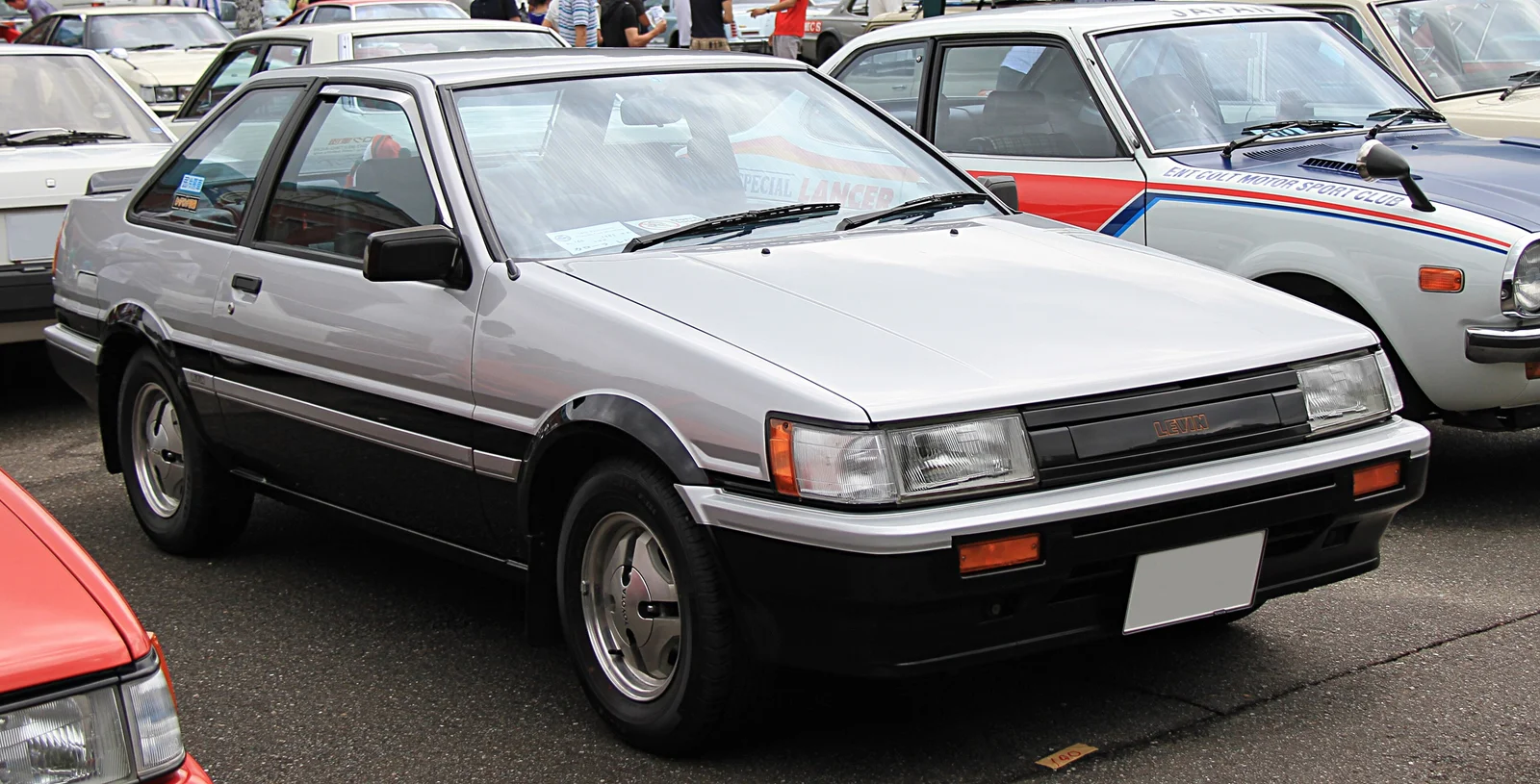
Hachi-roku is simply Japanese for eight-six, and it comes straight from the car's chassis code: the Toyota AE86. That is the entire origin of the nickname. There is no hidden meaning. Enthusiasts shortened the code to the two numbers, said them in Japanese, and the name stuck so hard that people who do not speak a word of Japanese still call the car the hachi-roku.
The more interesting question is why a cheap 1980s Corolla earned a nickname at all, let alone one that survives forty years later. Here is what the code means and why this particular little car became a legend.
Breaking Down the Code
Toyota's chassis codes follow a pattern, and AE86 decodes cleanly. The A refers to the engine family, the 4A series, which in this car means the 4A-GE. The E is for Corolla. The 8 marks the fifth-generation E80 platform. The 6 identifies the specific variant within that generation. So AE86 is shorthand for one exact configuration of Corolla, and hachi-roku is shorthand for the shorthand.
That precision matters, because the same E80 generation included front-wheel-drive versions. The AE86 is the one that kept the rear-wheel-drive layout, and that single detail is most of why it is remembered.
Levin and Trueno: One Car, Two Faces
Toyota sold the AE86 under two names. The Corolla Levin had fixed headlights. The Sprinter Trueno had pop-up headlights. The names fit the theme: Levin comes from an old English word for lightning, and Trueno is Spanish for thunder. Same car underneath, two front ends, and the pop-up Trueno is the one most people picture.
Why a Cheap Corolla Became a Legend
The AE86 arrived light, rear-wheel drive, and cheap, with a willing engine. The 4A-GE was a 1.6-liter twin-cam four with a cylinder head developed alongside Yamaha, happy to rev toward 7,800 rpm in its sharpest Japanese tune. None of the numbers were huge. The magic was the balance. A light car with power going to the rear wheels and a chassis that talks to the driver is a recipe for fun that no spec sheet captures.
That balance made the AE86 a natural for drifting as the discipline took shape, and it became one of the foundational drift cars precisely because it was affordable and forgiving at the limit. It was the car you could actually buy and learn on.
The Initial D Effect
Then a comic turned it into a worldwide icon. Initial D followed Takumi Fujiwara delivering tofu in his father's white-and-black Sprinter Trueno, outdriving more powerful machinery on mountain passes. The series put the hachi-roku in front of a global audience that had never seen one in person, and it cemented the car's reputation as the giant-killer. Prices for clean examples have climbed accordingly, which is its own kind of proof.
Toyota understood the legend too. When it revived an affordable rear-drive coupe, it leaned on the heritage directly, first with the 86 and then the GR86. The number in those names is not a coincidence.
The Hachi-Roku in the Faceoff Arena
An AE86 punches far above its spec sheet in a faceoff, because voters are not scoring horsepower. They are scoring everything the car represents: the JDM heritage, the drift history, the Initial D fame, and the simple rightness of a clean rear-drive Corolla. People who know cars recognize it instantly, and people who do not still feel that it matters.
Put a clean hachi-roku up against something newer and faster on WhipJury and watch how often the little Corolla still takes the vote.
Sources:
Chassis code, 4A-GE engine, Levin and Trueno, and drifting history: Wikipedia
The AE86 lineage through the 86 and GR86: Toyota UK Magazine
Frequently Asked Questions

Cam Walsh has been obsessing over cars since before he could drive one. Based out of Atlanta, Cam covers automotive design, car culture, and the eternal debate over which whips actually look the part.