A locker, short for locking differential, ties the left and right wheels on one axle together so both turn at the same speed, whether or not each one has grip. Off-roaders use them to climb out of spots where a normal axle would just spin one tire. Any axle that drives two wheels needs a differential, because in a turn the outside wheel travels farther than the inside one. A regular open differential lets the two wheels turn at different speeds. The catch, as Jalopnik explains, is that the torque reaching the wheel with good traction is limited by the wheel that's slipping. Lift one tire off a rock or park it on ice, and the tire that still has grip gets very little torque.
A limited-slip differential sits between the two. Eaton says its Detroit Truetrac, a helical-gear limited-slip, acts like an open differential in normal driving, then shifts torque to the wheel with more traction once one starts to slip. A typical Truetrac sends about three times the slipping wheel's torque to the gripping wheel. Do the math on a tire that's barely touching the ground: three times almost nothing is still almost nothing. A locker doesn't multiply anything. It just joins the axle shafts.
Air, electric, or automatic
Many lockers are selectable, which means they stay open until you press a button. The ARB Air Locker runs on compressed air. ARB says a dash switch sends air through a nylon line to the differential, and up to 12 return springs pull the locking gear back out when you switch it off. ARB builds the Air Locker in Melbourne, Australia, and says it can be engaged "at the flick of a switch at any speed."
Eaton's ELocker does the same job with an electromagnet. Eaton is more careful about timing than ARB. It "strongly suggests" engaging the ELocker only below 5 mph, with less than 50 rpm of difference between the two wheels, because the locker has to snap the slower wheel, axle shaft, and brake parts up to the speed of the spinning one all at once.
The Detroit Locker, also from Eaton, has no switch. Eaton says it stays locked when the vehicle goes straight, unlocks in turns so one wheel can freewheel, and locks again when the road straightens out. Owners hear it, too. Eaton's FAQ says the unit clunks in corners and when you lift off the gas, because of slack between its teeth. Its roots are on the drag strip as much as the trail: Eaton says the Detroit Locker was a factory option on some Detroit muscle cars in the 1960s.
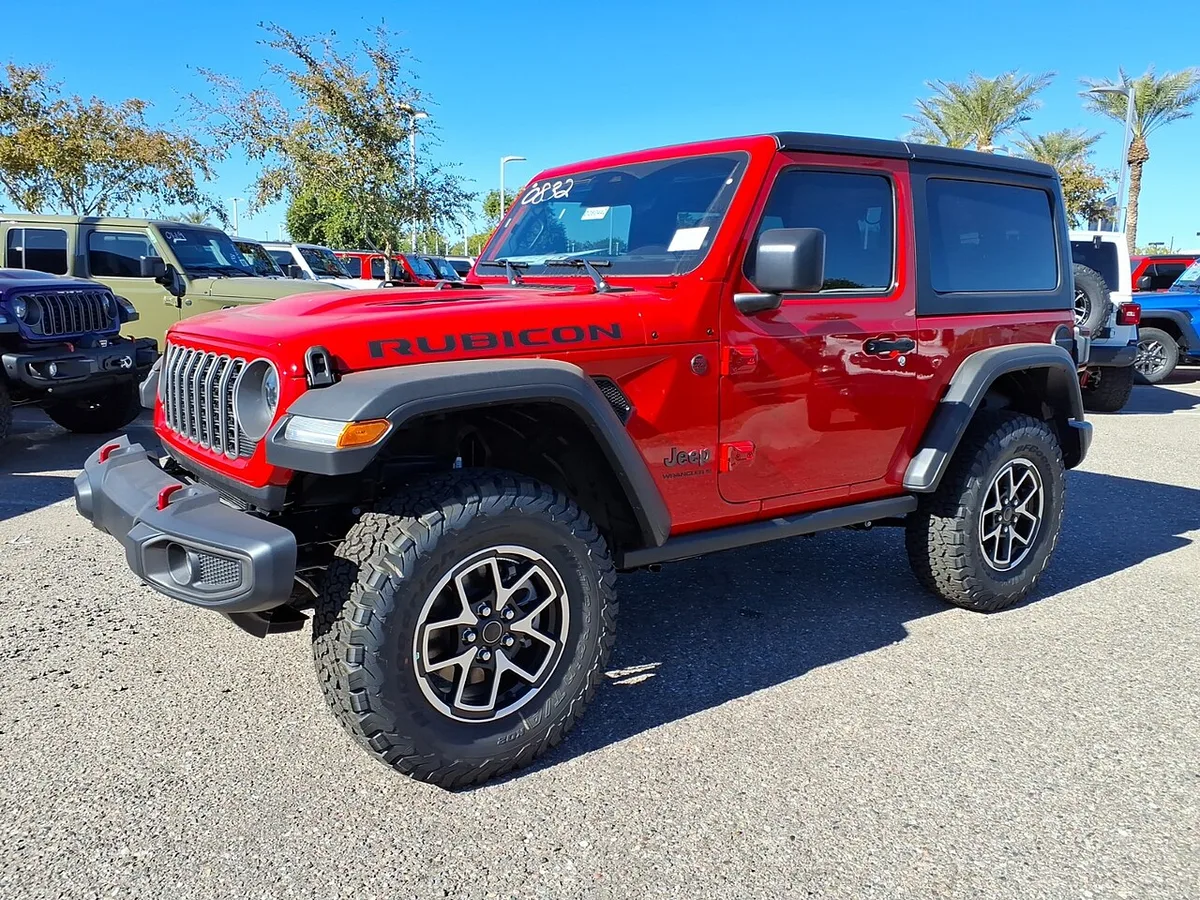
The factory lockers on today's trail trucks are selectable and electric. The 2026 Jeep Wrangler Rubicon has Tru-Lok electronic lockers in both its front and rear Dana axles, per Jeep's spec sheet, along with a 4.0:1 low range and an electronic front sway-bar disconnect. The Sport and Sahara get open differentials. Ford lists front and rear locking differentials as standard on the 2025 Ranger Raptor, with its 405-hp, 3.0-liter EcoBoost V6. On the Bronco, Ford Performance sells the rear axle from Sasquatch-package trucks as a service part, an M220 with a 4.70 ratio and an electronic locker, and warns that front and rear axle ratios must match.
Toyota sticks to the rear. The 2025 4Runner has an electronic locking rear differential standard on TRD Off-Road, TRD Pro, and Trailhunter grades, and Toyota says it splits power 50/50 between the rear wheels when traction is extremely limited. The 2025 Tacoma offers the same locker as an option. Ram says the 2027 Power Wagon, now offered with a 430-hp Cummins diesel, keeps its solid front and rear axles and electronic locking differentials, The Drive reported.
Front, rear, and pavement
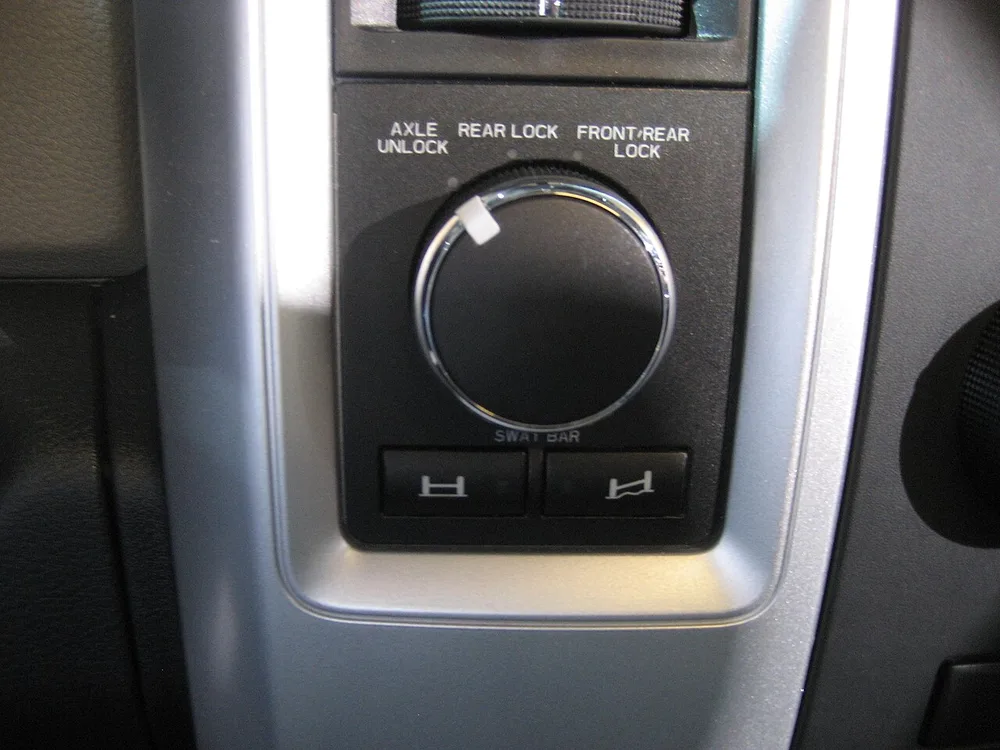
The dial on an older Power Wagon, shown above, reads Axle Unlock, Rear Lock, and Front/Rear Lock, in that order. Rear comes first. The front wheels also have to steer the truck, and Eaton is blunt about front lockers. Its FAQ calls a vehicle with a locked front differential "unsafe to use on an improved road" and says it makes steering extremely difficult and can damage the vehicle. That's why Eaton says an automatic Detroit Locker in a front axle needs selectable locking hubs for road use.
Pavement hurts at the rear, too. With both wheels forced to one speed, Jalopnik notes, a locker hurts the vehicle's ability to turn, because the inside tire can't slow down for the corner. Lock it when a wheel is spinning at crawling speed, on a rock ledge, in a rut, or in a ditch. Unlock it before the tires touch the road.
Strength is the other cost. Eaton says a fully locking differential can send up to 100% of the driveline torque through a single axle shaft, while other designs often send 50 to 70%. Most Detroit Locker failures, the company says, start with a broken axle shaft.
You can't see a locker from the curb, so a Rubicon gives itself away with the parts around it. Jeep fits LT285/70R17 BFGoodrich All-Terrain T/A KO2 tires and a 64.4-inch track, 1.5 inches wider than the standard 62.9 inches.
Put the Rubicon up against a Bronco and pick the better-looking trail truck on WhipJury.
Sources:
Wrangler Rubicon lockers, axles, low range, sway-bar disconnect, tires, and track: Jeep 2026 Wrangler specifications
How open, limited-slip, and locking differentials behave, and how lockers affect turning: Jalopnik
The Truetrac and its torque bias: Eaton and Eaton Truetrac FAQ
The ELocker and its engagement guidance: Eaton and Eaton ELocker FAQ
The Detroit Locker, its noise, its history, front-axle use, and axle-shaft loads: Eaton and Eaton Detroit Locker FAQ
The Air Locker: ARB
Ranger Raptor lockers and output: Ford
The Sasquatch rear axle: Ford Performance
The 4Runner rear locker: Toyota
The Tacoma rear locker: Toyota
The diesel Power Wagon: The Drive
Photos via Wikimedia Commons: HJUdall and Dana60Cummins (CC0 1.0)
Frequently Asked Questions

Cam Walsh has been obsessing over cars since before he could drive one. Based out of Atlanta, Cam covers automotive design, car culture, and the eternal debate over which whips actually look the part.