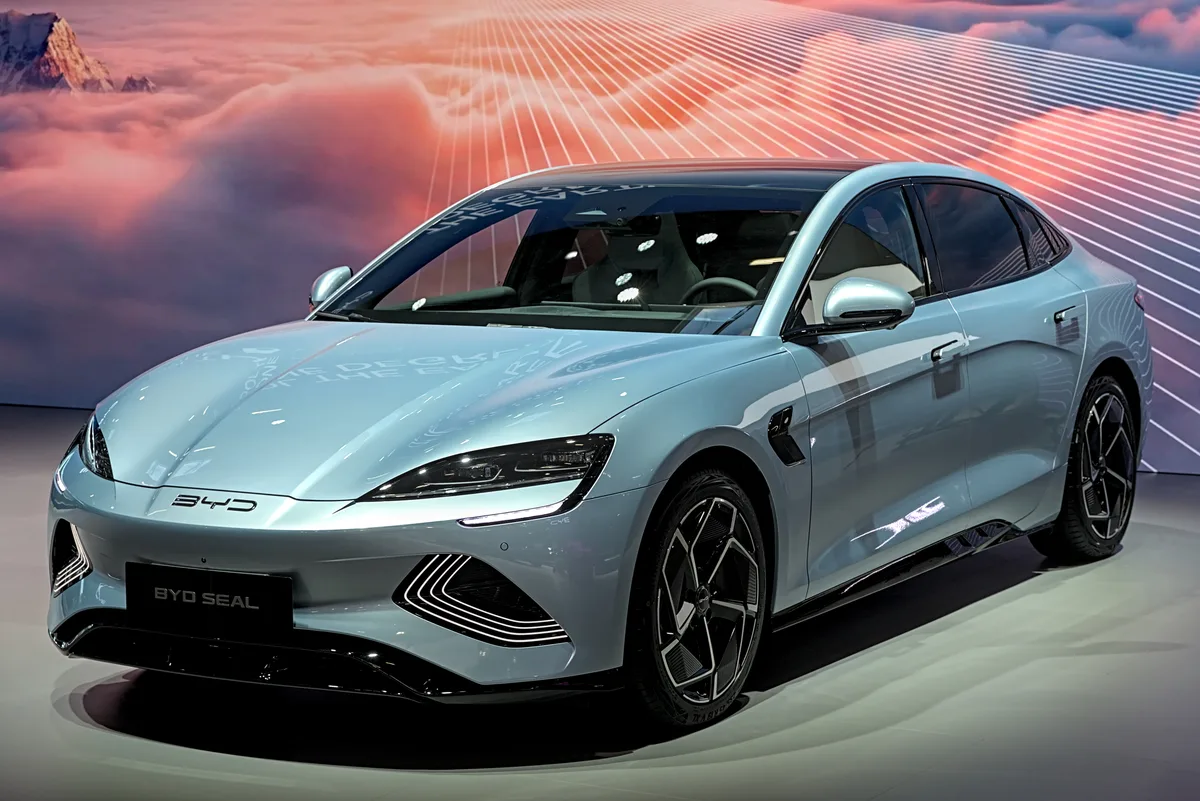
The first thing Americans notice about a BYD Seal or a Zeekr 001 is that it doesn't look Chinese, whatever they expected that to mean. It looks more... European. That's because, for the most part, Europeans designed it.
Over the past decade China's EV makers hired the people who drew the cars you already admire, gave them budgets and freedom, and let them work without a hundred years of brand heritage telling them what a grille has to look like. The result is a design language with a few clear traits, and once you know where they came from they make sense.
The designers came from Audi, BMW, and Bentley
Wolfgang Egger, who ran design at Alfa Romeo, Audi, and Lamborghini, has led BYD design since 2017. The Han, Dolphin, Atto 3, and Seal are his team's work, and the Seal in particular reads like an Audi that was allowed to relax. Kris Tomasson, formerly of BMW and Ford, has led Nio design since 2015 from a studio in Munich, which is why an ET7 has the proportions of a German executive sedan. Stefan Sielaff, who drew the Audi A7, the Mercedes CLS, and the Bentley Bentayga, has run global design for Geely, Zeekr's parent, since 2021.
That's three of the most influential surfacing designers of the last 25 years, working for three Chinese brands. When a Zeekr looks like a Bentayga from certain angles, the same hand drew both designs.
The traits, and where they come from
The first trait is smooth, full-surface bodywork with very few creases. That's partly the designers, who came from brands that prize surfacing, and partly the platform. An EV has no engine to package up front, so there's no reason for a tall hood or a big grille, and the skateboard chassis under the floor lets the cabin stretch. So you get long wheelbases, short overhangs, and a low, uninterrupted nose.
The second is the full-width light bar, front and rear, which almost every Chinese EV wears. It solves the grille problem, since a car with no grille needs something to give the face an identity, and a lit strip does that at night better than chrome ever did.
The third is that the interior is the product. Li Auto sells its L9 as a family living room with a fridge, a rear screen, and reclining seats, and the Zeekr 009 and XPeng X9 have made the minivan a luxury object again. Chinese buyers spend a lot of time being driven in traffic, and the cars are drawn from the inside out to reflect that.
What's missing, and whether it matters
The fair criticism is that the cars are polished without being distinctive. Because the designers came from the same few European schools and the platforms push toward the same proportions, a lot of Chinese EVs could swap badges and few people would notice. There's no Chinese equivalent yet of the thing that makes a Porsche a Porsche across 60 years. That takes time, and most of these brands are under a decade old.
The other thing to watch is that the traffic is turning around. The Leapmotor C16 and Li Auto L8 pages on this site draw real search traffic from people outside China trying to figure out what these cars are, and Western designers are now taking jobs at Chinese studios rather than the reverse.
Whether the look holds up next to the cars it was borrowed from is the open question. Put a BYD Seal against the Audi it resembles on WhipJury and see which one the crowd picks when the badges are ignored. If you want the brand-by-brand basics first, start with who BYD, Nio, Zeekr, and Leapmotor actually are.
Sources:
Western designers at Chinese brands, including Egger at BYD and Tomasson at Nio: Motor1
Egger's career and BYD models: Wikipedia, Wolfgang Egger
Designer moves to Chinese studios: Car Design News
Frequently Asked Questions

Jeffrey Wiley has spent more time than he'd like to admit thinking about what makes a car look right. He writes about automotive design, car culture, and the opinions people have strong feelings about. He lives in north Georgia.