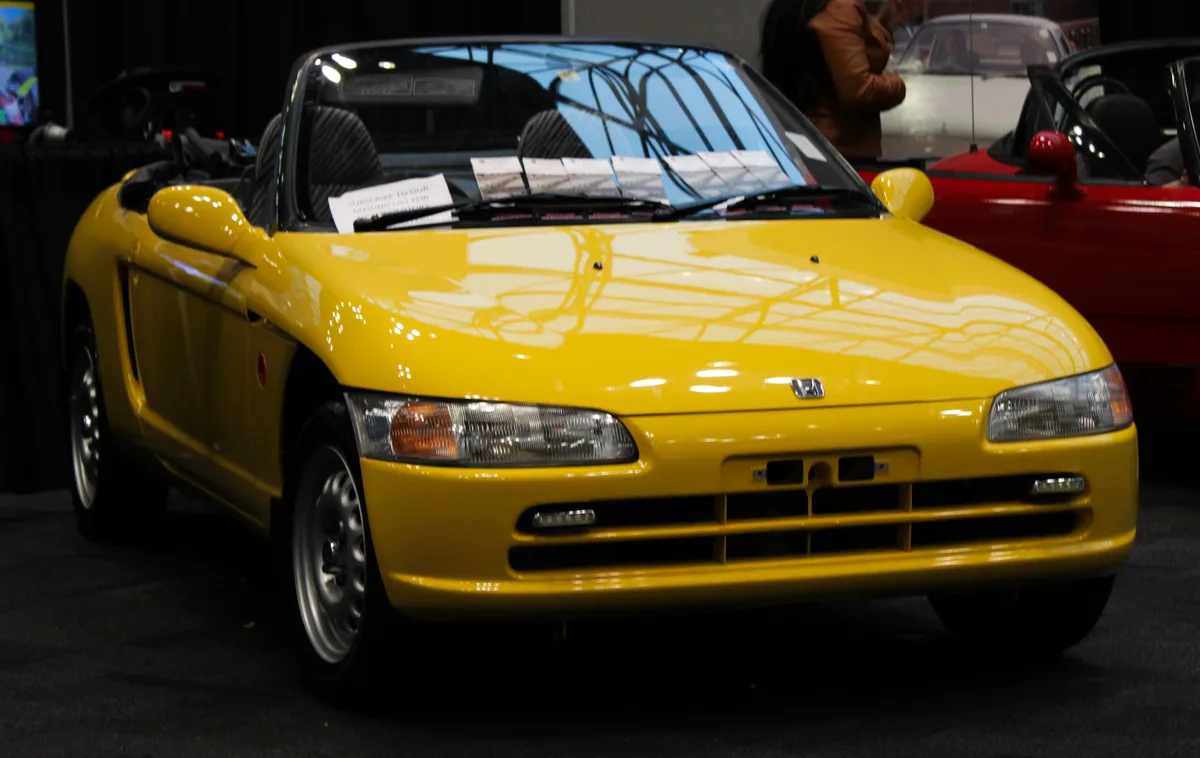
The Honda Beat is a two-seat convertible with the engine behind the seats, rear-wheel drive, a 656cc three-cylinder that spins to an 8,500 rpm redline, and 63 horsepower. It weighs 1,680 pounds. It is, in every way that matters except size, a proper sports car, and it fits in a parking space most cars can't use.
They're arriving in the United States now, because cars built in 1996 and earlier have cleared the 25-year import rule, and Americans are discovering what Japan has known since 1991.
What Honda actually built
The Beat is a kei car, which means it was built to Japan's smallest vehicle class, with hard legal caps on length, width, and engine displacement. Most kei cars are boxes for getting around cities. Honda used the same rulebook to build a mid-engined roadster.
The engine is the E07A, a 656cc naturally aspirated inline-three making 64 PS, about 63 horsepower, at 8,100 rpm. Honda gave it MTREC, short for Multi Throttle Responsive Engine Control, which means a separate throttle body for each of the three cylinders. Individual throttle bodies are what you find on race engines and on Ferraris. Honda put them on a car with a 656cc motor because it wanted the throttle response.
The result is a car with almost no power that has to be driven flat out to do anything, which is the most fun a car can be on a public road. Top speed was electronically capped at 84 mph. You will use all of it, and all of the revs, constantly.
Pininfarina drew it, and Soichiro Honda approved it
The shape came from Pininfarina, the Italian house behind decades of Ferraris, which sold the design to Honda, where Pavel Husek developed it further. That's why the proportions work at a size where they usually don't. The nose is low, the wheels sit at the corners, and the body has almost no overhang, so it reads as a scaled-down sports car rather than a small car with a roof cut off.
It was also the last car Soichiro Honda personally approved before his death in 1991, which is a fitting last signature from a company founder who spent his career arguing that small engines revving hard were the honest way to make power.
Honda built around 33,600 of them between May 1991 and February 1996, and roughly two-thirds sold in the first year. The rest of the run was slow, and that's the pattern with cars like this. Everyone is delighted it exists, then far fewer people buy one.
Why it matters now
Values have been climbing as the Beat has become importable, and it sits in a very small club with the Suzuki Cappuccino and the Autozam AZ-1 as the kei sports cars of the early 90s. Honda revisited the idea decades later with the S660, which never came here either.
The thing worth taking from it is how much car you can get from very little. A Beat has the layout of an NSX and a fraction of everything else, and it still looks like something you'd stop and photograph. Size is not the same thing as presence.
Put one against an MX-5 on WhipJury and see whether the crowd rewards the smaller, stranger, more committed car.
Sources:
Engine, output, weight, layout, production run and the Soichiro Honda approval: Wikipedia, Honda Beat
Output at 8,100 rpm, MTREC throttle bodies, weight and total built: autoevolution
Frequently Asked Questions

Cam Walsh has been obsessing over cars since before he could drive one. Based out of Atlanta, Cam covers automotive design, car culture, and the eternal debate over which whips actually look the part.