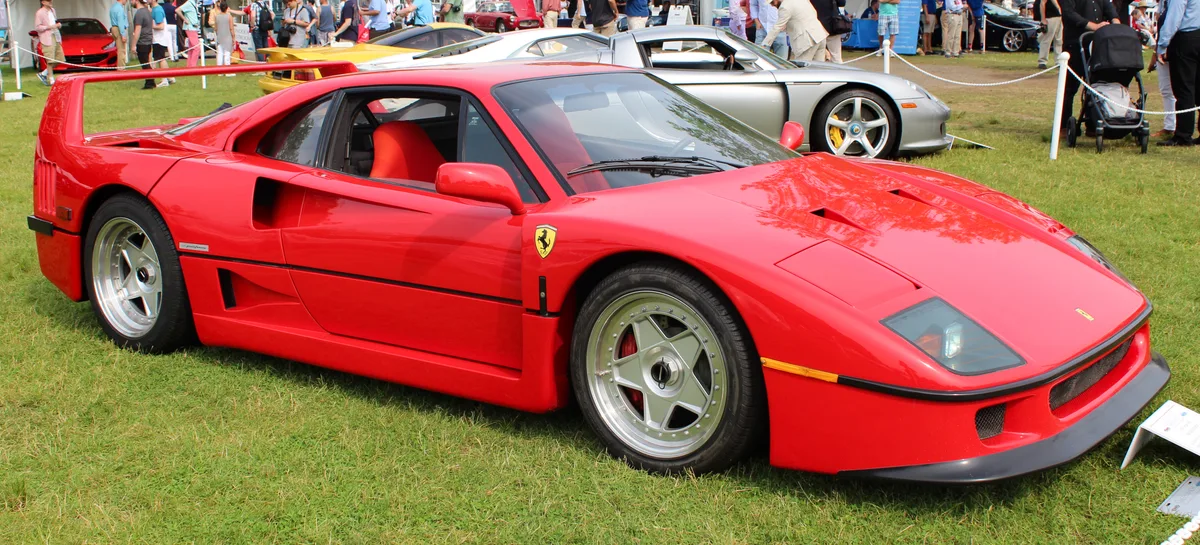
A Ferrari F40 is worth somewhere around $3 million. Market trackers put the average sale near $3.05 million, with half of all sales landing between roughly $2.4 million and $3.8 million. That's the TLDR answer, but the spread is the interesting part, because two F40s can be separated by millions of dollars.
What moves the number
An honest, higher-mileage car that has actually been driven starts near $1.8 million. At the other end, delivery-mileage cars and single-owner estate examples have reached about $6.6 million.
That gap exists because the F40 sits in two markets at once. One set of buyers wants a car to drive, since the F40 is famously raw, with no power steering, no traction control, and a twin-turbo V8 that arrives all at once. Another set wants an untouched artifact, and those buyers are the ones paying the top numbers.
History matters on top of that. Documented ownership, matching numbers, and a clean service record separate a good car from a great one, and numbers-matching originality is worth real money at this level.
How it got here
The F40 spent a long time being merely expensive. Average prices roughly tripled between 2014 and 2024, moving from about $1.1 million to around $3.2 million.
Since then the market has settled. Prices have stabilized into a band rather than climbing every year, which usually signals a car that has finished being discovered and is now simply established.
For context, the 288 GTO before it and the Enzo after it occupy similar territory, and the 250 GTO sits in a different universe entirely at around $70 million.
Why people pay it
Ferrari built roughly 1,315 F40s, and it was the last car Enzo Ferrari personally signed off on before his death. That combination of a real story and a moderate production run is what supports the price.
The looks help more than people admit. The F40 has no decoration at all. The huge rear wing, the NACA ducts, and the slatted engine cover are there because the car needed them, and the composite panels are so thin you can see the weave through the paint. Forty years on it still reads as serious rather than styled, which is why Lewis Hamilton went looking for one after selling everything else.
Put an F40 against a modern hypercar on WhipJury and see whether four decades changed what a fast car should look like.
Sources:
Market range and recorded sale prices: The Classic Valuer
Current price band by condition: hyper.luxe
Top-end results for low-mileage cars: RM Sotheby's
Frequently Asked Questions

Jeffrey Wiley has spent more time than he'd like to admit thinking about what makes a car look right. He writes about automotive design, car culture, and the opinions people have strong feelings about. He lives in north Georgia.