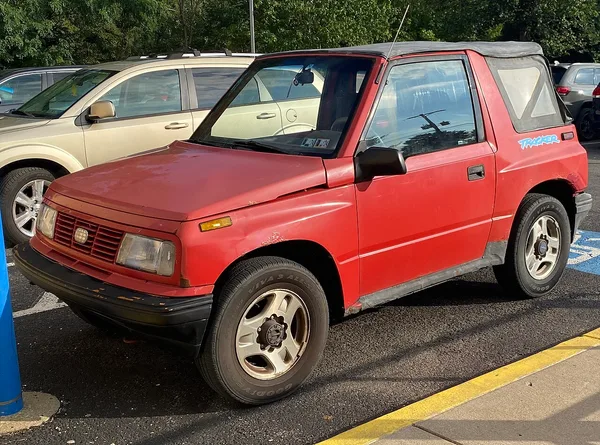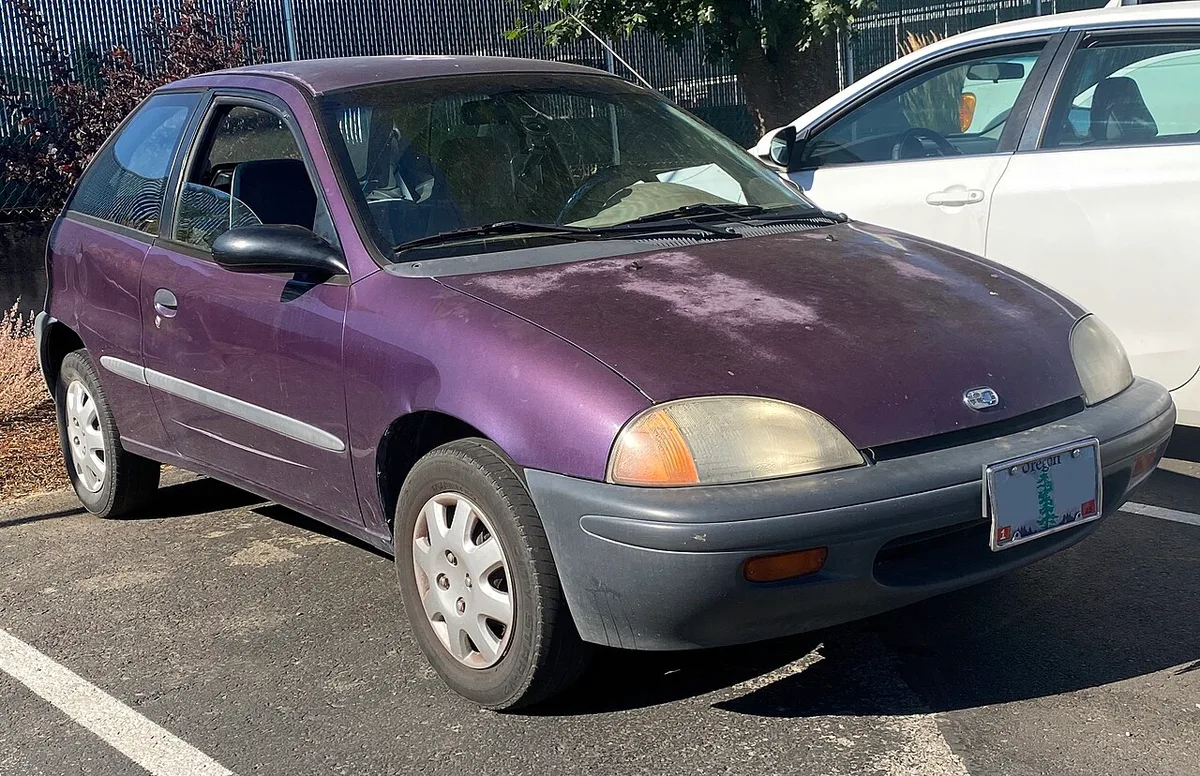
Chevrolet stopped making the Metro, the car most people know as the Geo Metro, in April 2001, and 2001 was its final model year in the US. Just Auto reported that CAMI Automotive, the General Motors and Suzuki joint venture plant in Ingersoll, Ontario, ended production of the Chevrolet Metro and its twin, the Suzuki Swift, that April and cut about 500 jobs. The EPA's fuel economy database lists Chevrolet Metros from 1998 through 2001 and none for 2002. The Geo badge went away sooner. Consumer Guide says the Geo brand lasted through the 1997 model year, and the Metro moved to Chevrolet for 1998 with a bow tie and new headlamps. The final cars got a quiet send-off. Consumer Guide says the 2001 Metro was sold only through rental outlets, and The Truth About Cars notes that only the four-cylinder LSi sedan was left. The EPA lists one 2001 version, a 1.3-liter four with a three-speed automatic, rated at 26 mpg city, 31 highway, and 28 combined.
One Suzuki, several badges
The Metro was a Suzuki Cultus. For 1985, GM put Chevrolet badges on the Cultus and sold it as the Sprint in the US and as the Pontiac Firefly in Canada, according to Hagerty. GM launched Geo in 1989 to sell cars built or designed by its Japanese partners, and the Cultus was sold as the Geo Metro from the 1989 model year. Geo franchises went only to existing Chevrolet dealers, and about 80 percent of them signed on.
GM and Suzuki announced the $500 million Ingersoll plant on August 27, 1986. CBC reported that it was meant to build 200,000 vehicles a year with 2,000 workers, in a town of 8,500 best known for its cheese. It was the first time an Asian automaker building a plant in Canada agreed to the terms of the US-Canada auto pact, and Suzuki would spend $200 million a year on Canadian-made parts. Early Cultus-based cars came from a Suzuki plant in Japan. Starting in 1990, CAMI built them all, Consumer Guide says. The same line turned out the Metro, the Swift, and the Firefly, which Pontiac sold in Canada from 1985 to 1991 and again from 1994 to 2001. The trio is a tidy case of badge engineering.
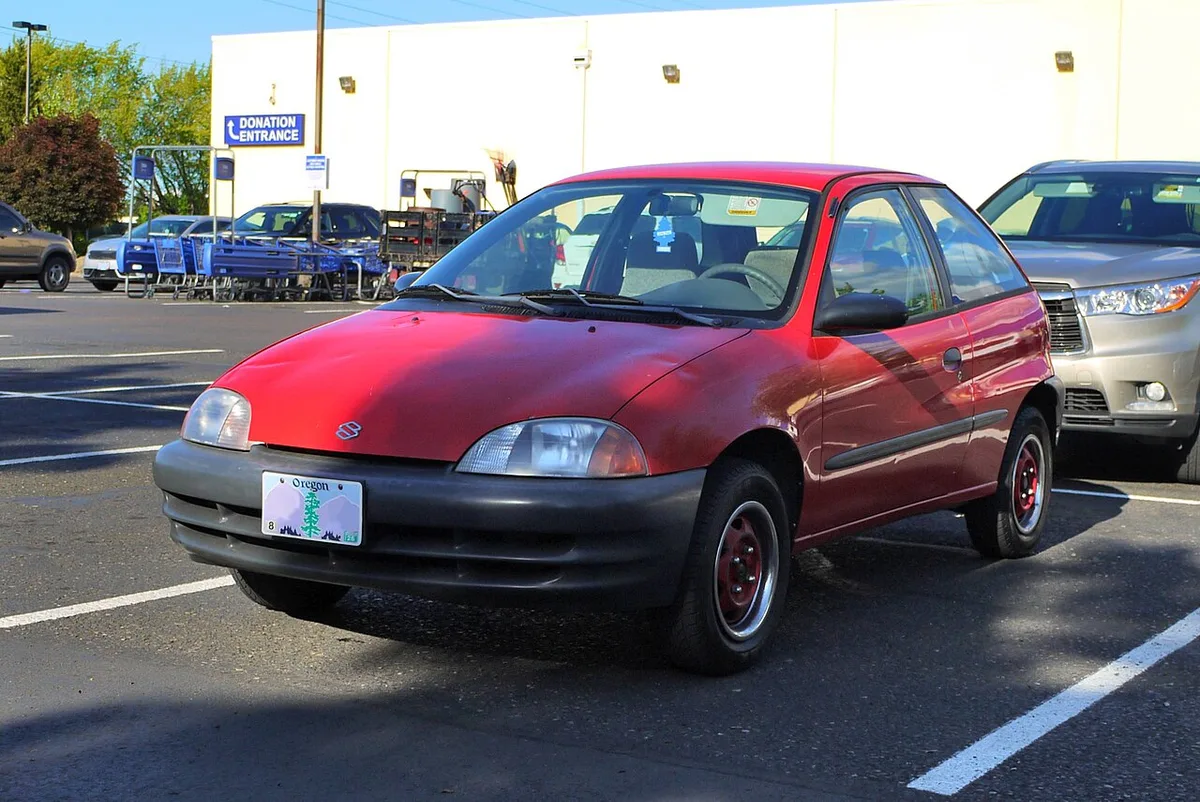
The first Geo Metro got a facelift for 1992, with a new nose, full-width taillamps, and a new dashboard with a cupholder. It was redesigned for 1995 with a new body, standard dual airbags, and an optional 70 hp 1.3-liter four. The two-door hatchback rode on a 93.1-inch wheelbase, and a sedan more than a foot longer replaced the old four-door hatchback. The 1998 move to Chevrolet also brought a stronger four-cylinder. Just Auto notes that the Canadian cars got a full exterior and interior restyle in the mid-1990s, while Suzuki kept building the older design in Japan and Hungary.
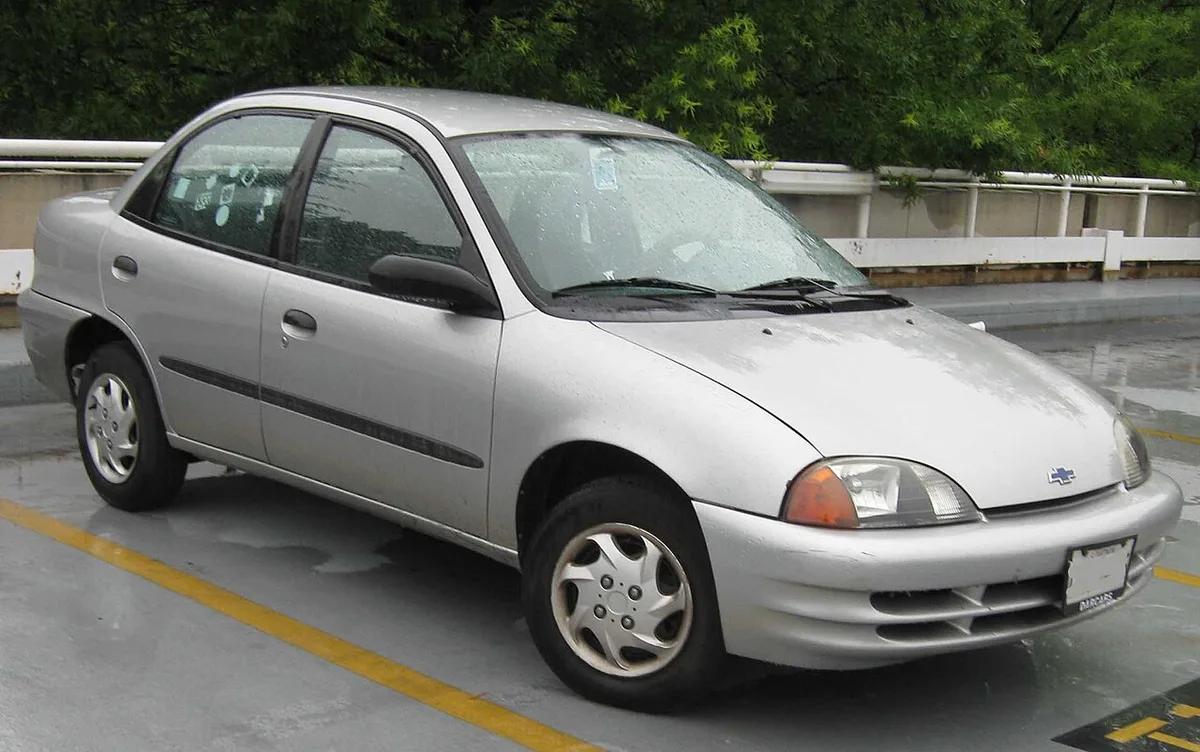
The XFi, falling sales, and the end
The Metro built its name on mileage. For 1990, the most frugal version got the XFi badge. It came only as a two-door with a five-speed manual, and its 1.0-liter three-cylinder made 49 hp, against 52 or 55 hp in other Metros, Consumer Guide says. The EPA rates the 1990 to 1994 XFi at 43 mpg city, 52 highway, and 47 combined under its current method. That beats the 41 mpg combined the EPA gives the 2001 Toyota Prius hybrid, and it's 19 mpg better than the last 2001 Metro.
Buyers wanted bigger cars. WardsAuto reported in December 1998 that Metro and Tracker sales fell as buyers "decided that bigger is better." Chevrolet sold 88,700 Metros in 1996 and 55,600 in 1997, and by October 1998, Metro sales were down 57 percent from 1997. CAMI had peaked in 1995 at 183,000 vehicles, most of them Metros and Trackers. Just Auto put the Swift and Metro line's peak at more than 100,000 cars a year, falling to 32,000 in 2000. The Daewoo-developed Chevrolet Aveo eventually took the Metro's place.
Expensive gas brought the Metro back into demand. Hagerty writer Rob Siegel bought a 1999 Chevy Metro with the 55 hp three-cylinder in 2008 and got 53 mpg driving from Boston to New Jersey at 55 mph, then 45 mpg on the way back at about 70 mph. When gas prices spiked that fall, Siegel wrote, cheap economy cars became hot commodities, and "the Metro led the pack." In 2021, a 2000 Chevrolet Metro with 402 miles sold on Bring a Trailer for $19,110 including buyer's premium, Hagerty reported, against an original window sticker of $11,140. That car had the base six-valve 1.0-liter three, rated at 55 hp and 58 lb-ft, with a five-speed manual.
The design underneath outlived the Metro by years. The Truth About Cars notes that its platform stayed in production as the Suzuki Cultus for Pakistan through 2016.
Put the Metro and its Swift twin head to head on WhipJury.
Sources:
The April 2001 end of production, the 500 jobs, the mid-1990s restyle, and Swift and Metro output: Just Auto
The Chevrolet Metro model years, 1998 to 2001: EPA and DOE, fueleconomy.gov
The XFi, 2001 Metro, and 2001 Prius ratings: EPA and DOE, fueleconomy.gov
The 1995 redesign, the 1998 move to Chevrolet, and the rental-only 2001 cars: Consumer Guide
The 1992 facelift and the XFi's body, transmission, and horsepower: Consumer Guide
The Geo brand's years and dealer sign-up: Consumer Guide
The Firefly's years and the move from Japan to CAMI: Consumer Guide
The 1985 Sprint and Firefly and Geo's 1989 launch: Hagerty
The Sprint to Metro lineage and the Geo Metro model years: The Truth About Cars
The sedan-only 2001 lineup, the Aveo, and the Pakistan Cultus: The Truth About Cars
The plant announcement, its targets, and the auto pact terms: CBC
Metro sales, the 1995 peak, and the shift to bigger vehicles: WardsAuto
Siegel's 1999 Metro and its mileage: Hagerty
The 402-mile Metro sale and its engine specs: Hagerty
Photos via Wikimedia Commons: Cutlass and ITakePhotosOfCars (CC0) and IFCAR (public domain)
Frequently Asked Questions

Cam Walsh has been obsessing over cars since before he could drive one. Based out of Atlanta, Cam covers automotive design, car culture, and the eternal debate over which whips actually look the part.