Geo Tracker
Classic · Geo
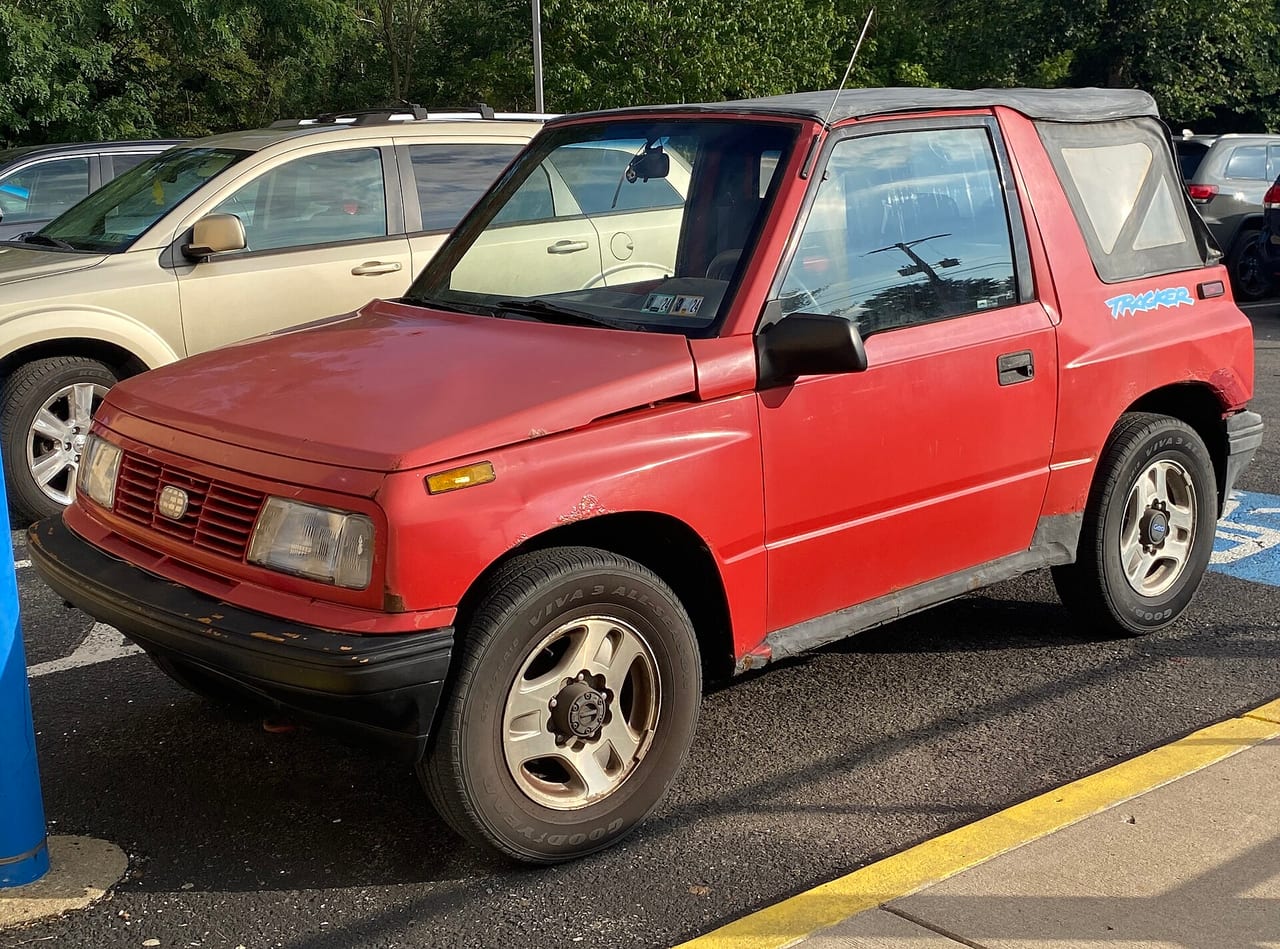
Geo Tracker: The Little 4x4 Built With Suzuki
The Geo Tracker is a mini SUV introduced in late 1988 as a 1989 model, developed with Suzuki as a near twin of the Suzuki Sidekick. It became the Chevrolet Tracker for 1998 and stayed in production until January 2004.
Trackers were meant to come from CAMI, the GM and Suzuki joint venture in Ingersoll, Ontario, but nearly all 1989 and some 1990 models were built in Japan because of factory delays. At first, every Canadian-built Tracker went to the United States to get around the 25 percent "Chicken Tax," a US tariff on imported light trucks. Power came from Suzuki's 80 hp 1.6-liter four, and every Tracker was four-wheel drive until a two-wheel-drive convertible arrived in 1992.
The Tracker was built like a small truck. It rode on a light-truck chassis, was certified as a light truck, and used a hi-lo transfer case, a recirculating-ball steering box, and a conventional light-truck rear axle on coil springs. The ride was truck-like as a result, but the payoff was durability in harsh conditions. The two-door hardtop was dropped after 1995 to make way for a four-door hardtop wagon for 1996.
A second-generation Tracker arrived for 1999, sold by Suzuki in North America as the Vitara. Production in Ingersoll ended on January 27, 2004, and the Chevrolet Equinox replaced it there. A 1995 IIHS report found 3.2 driver deaths per 10,000 registered 1991 to 1993 two-wheel-drive Trackers, against 1.6 for small utility vehicles overall, but the study was widely criticized, and a later IIHS study found four-door Trackers better than average for the class.