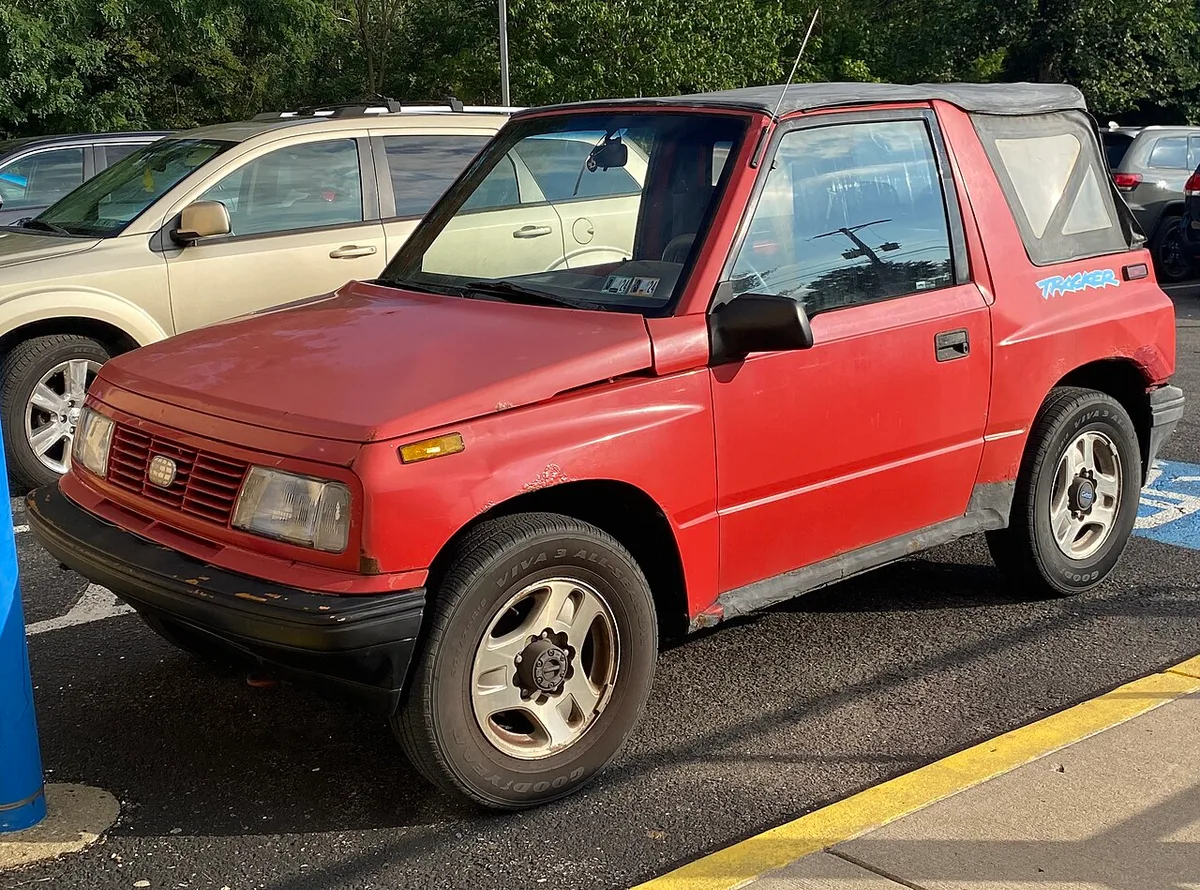
Yes. The Geo Tracker and the Chevy Tracker are the same small SUV, a twin of the Suzuki Sidekick, which Suzuki sold in Japan as the Escudo. It wore Geo badges for the 1989 to 1997 model years and Chevrolet badges from 1998 to 2004, after GM folded Geo into Chevrolet. The switch itself was a badge swap. Reviewing the 1998 lineup, The Auto Channel said the former Geo models were still on sale "but with a Chevy bowtie instead of the Geo globe." A redesigned second generation, closely related to the Suzuki Vitara, followed for 1999. The Tracker is a clean example of badge engineering, one design sold under several brand names.
The design started at Suzuki. The company launched the Escudo in Japan in May 1988 as a compact SUV aimed at city drivers, pairing a ladder frame with real off-road hardware. In 1989, through its partnership with GM, Suzuki began building it at CAMI in Canada as the Sidekick for North America, while its Iwata plant in Japan built export versions named Vitara. Suzuki says the first-generation Escudo sold 1.35 million units worldwide.
CAMI was the GM and Suzuki joint plant in Ingersoll, Ontario. The two companies formally announced the $500 million project on August 27, 1986, and CBC reported that day that it was slated to build 200,000 vehicles a year with 2,000 workers. Production started in 1989, and The Detroit News listed Ingersoll as the build site in its review of the 1996 Tracker.
The Geo years and the 1998 switch
The first Geo Trackers came as a two-door convertible and a two-door hardtop, both with 4WD, according to the federal fueleconomy.gov database. Two-wheel-drive convertibles show up in its listings by 1991. Power came from a 1.6-liter four, which made 95 hp in the 1996 Tracker that Cars.com tested.
The four-door hardtop arrived for 1996. The Detroit News listed four doors, a new grille, new fascias, and a new hood among the changes, and an IndyStar review said the four-door added 11 inches of wheelbase and 15 inches of overall length. A new four-speed automatic was offered only on the four-door. A 1996 four-door LSi started at $15,710.
GM retired the Geo name after 1997. Cars.com describes Geo as a GM brand from 1989 to 1997 that sold "restyled, rebadged versions of Japanese cars." The 1998 Chevrolet Tracker kept the first-generation body. The Auto Channel's review of a 1998 four-door 4WD listed a $15,605 base price and the same 95 hp, and it noted that Chevrolet had put its bowtie emblem on the nose.
The second generation arrived for 1999. Cars.com called it "a collaboration with Suzuki, which sells a very similar vehicle called the Vitara," and said Chevy designers took a bigger role in styling it. A 2.0-liter four replaced the 1.6 in the four-door hardtop, and MotorWeek listed that engine at 127 hp and 134 lb-ft. The two-door kept a 1.6, now rated at 97 hp. MotorWeek priced the 4WD two-door convertible from $14,735, and a well-optioned 2.0-liter tester came to $19,270. The larger four-door started at $14,835 with 2WD, per Cars.com. Fueleconomy.gov lists the Chevrolet Tracker through the 2004 model year.
4WD Trackers used truck-style hardware. Suzuki designed the original with the transfer case built as one unit with the transmission. The 1996 model used a part-time 4WD system with a floor lever for high and low range, per Cars.com, and The Auto Channel described optional skid plates under the 1998 truck's two-speed transfer case. For 1999, MotorWeek reported automatic locking hubs for shift-on-the-fly use, along with the two-speed transfer case. Two-wheel-drive versions were sold too.
Badges, grilles, and the Canadian Sunrunner
The twins are easiest to tell apart from the front. eBay Motors notes that the biggest difference between the Sidekick and Tracker was the badge and some paint color options. Geo-era Trackers wore the Geo globe, the 1998 Chevrolet swapped it for a bowtie, and Suzuki used its own S emblem. In the two 1998 examples below, the Chevrolet has a body-colored grille with the bowtie at its center, while the Sidekick has a black grille with the Suzuki S.
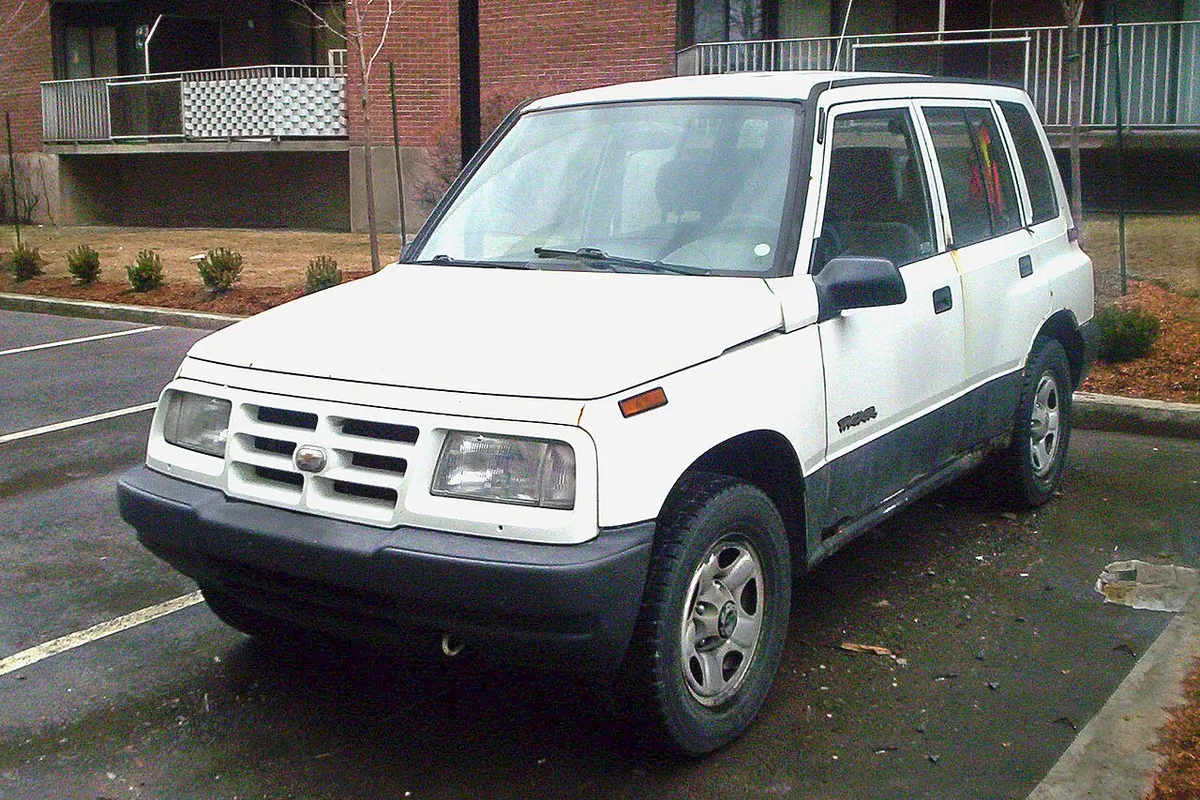
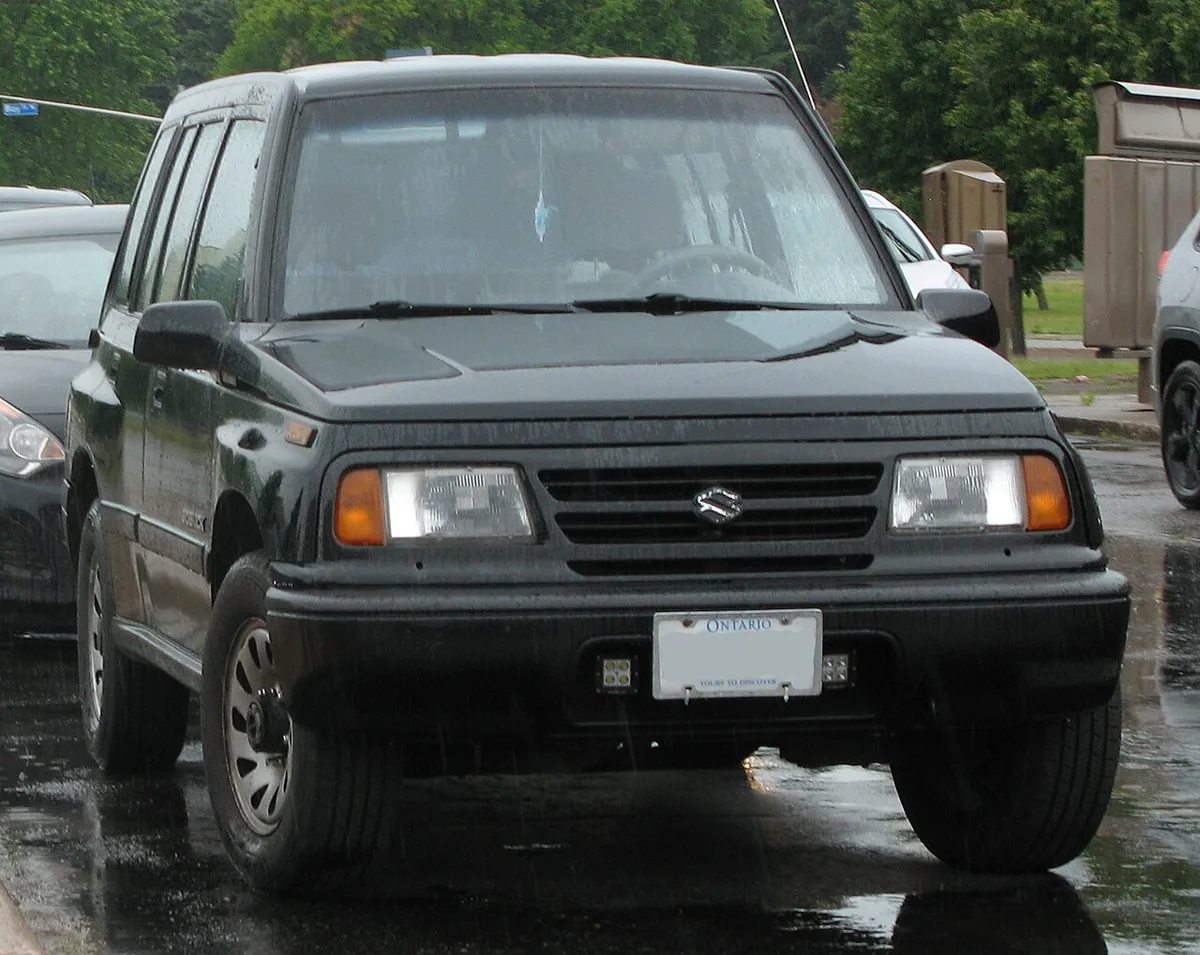
Canada got even more names. GM's Canadian Asüna brand sold the truck as the Sunrunner starting in 1992, according to The Truth About Cars. The Drive calls the Sunrunner a rebadged Geo Tracker, which was itself a rebadged Suzuki Sidekick. GM killed Asüna in 1994 and moved the Sunrunner to Pontiac, and The Autopian says the Pontiac Sunrunner lasted through the 1998 model year, with no Sunrunner version of the second-generation truck.
The Tracker name is still in use. GM Brazil announced commercial production of an updated Chevrolet Tracker SUV at its São Caetano do Sul plant on July 1, 2025, according to MarkLines, more than 20 years after the last Suzuki-based Tracker.
Put the Geo, Chevy, and Suzuki faces side by side and cast your vote on WhipJury.
Sources:
Geo Tracker model years, body styles, and 2WD versions: fueleconomy.gov
Chevrolet Tracker model years: fueleconomy.gov
The Escudo launch, CAMI production of the Sidekick, the Vitara name, the 1.35 million sales, and the transfer case design: Suzuki
The CAMI announcement, cost, planned output and staffing, and 1989 start:CBC
The Geo globe to Chevy bowtie switch: The Auto Channel
The 1998 Tracker price, output, bowtie, and two-speed transfer case: The Auto Channel
The 1996 changes, the Ingersoll build site, and the Geo brand description:The Detroit News via Cars.com
The four-door's added length and the automatic: IndyStar via Cars.com
The 1996 engine, price, Sidekick twin, and 4WD lever:Cars.com
The 1999 Vitara link, styling, engines, and four-door price:Cars.com
The 1999 2.0-liter output, prices, locking hubs, and transfer case:MotorWeek
Badge and paint differences: eBay Motors
The Asüna Sunrunner launch: The Truth About Cars
The Sunrunner lineage and the end of Asüna: The Drive
The Pontiac Sunrunner years: The Autopian
The current Chevrolet Tracker in Brazil: MarkLines
Photos via Wikimedia Commons: Cutlass (CC0), Bull-Doser (public domain), and SsmIntrigue (CC BY-SA 4.0)
Frequently Asked Questions

Cam Walsh has been obsessing over cars since before he could drive one. Based out of Atlanta, Cam covers automotive design, car culture, and the eternal debate over which whips actually look the part.