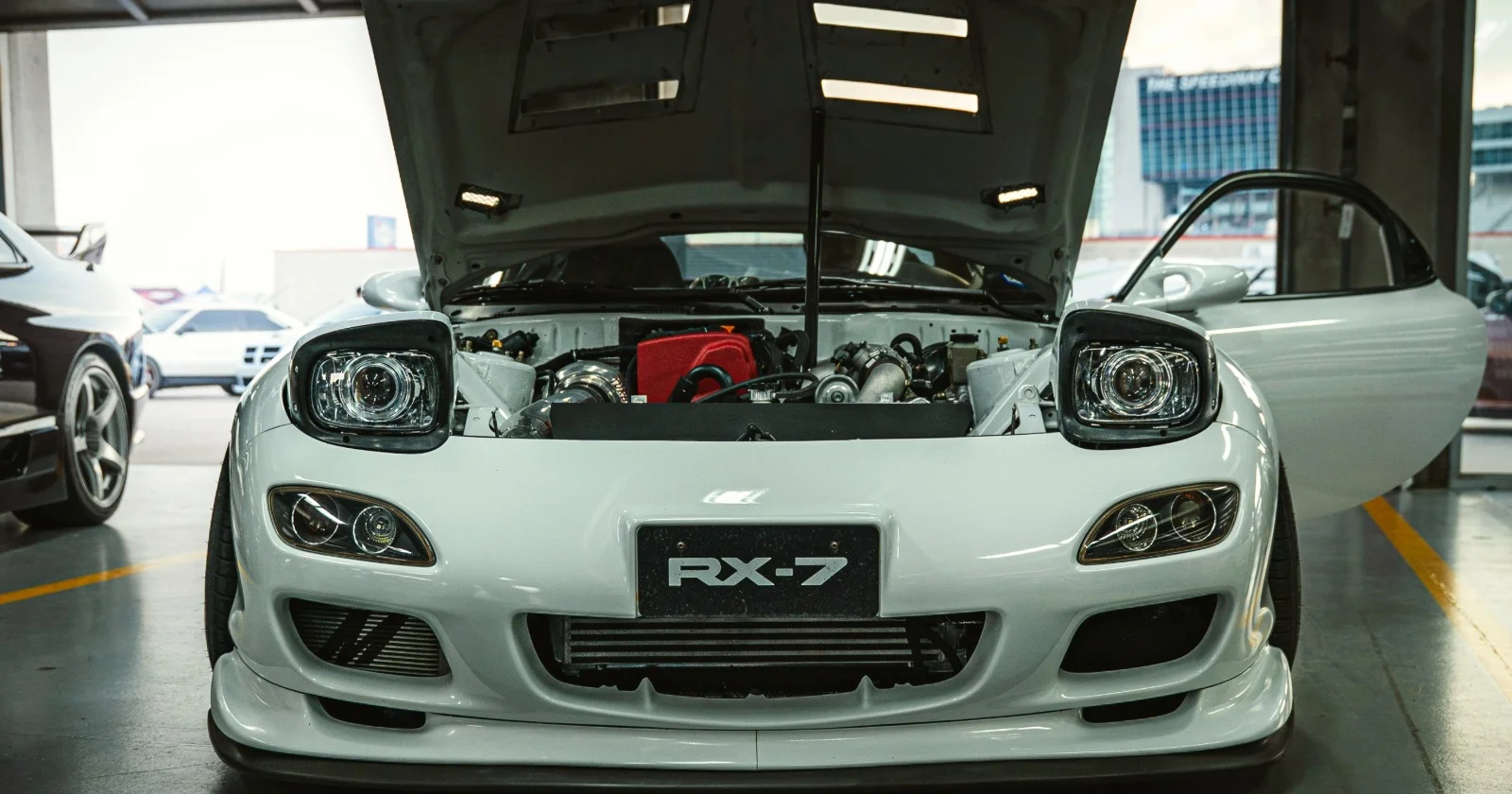
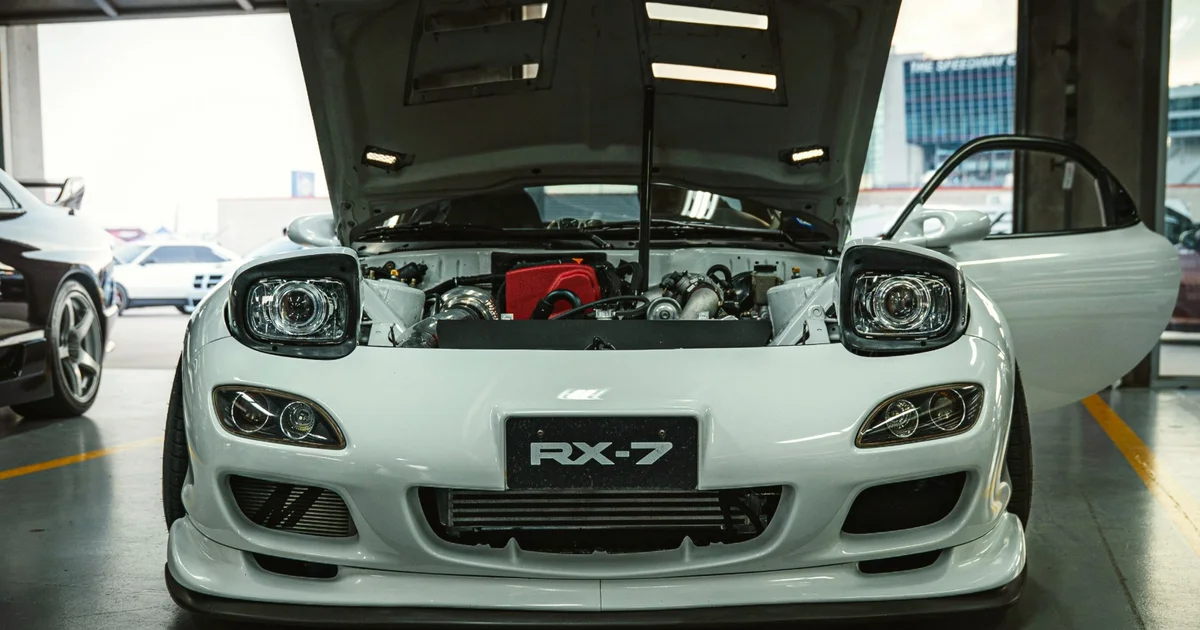
The Mazda RX-7 FD was designed in 1989 and went on sale in 1992. It's now over thirty years old. It still looks better than most cars being built today. That's not nostalgia talking. Park one next to a current-generation crossover or a mid-size sedan and the RX-7 wins the visual argument without trying, which raises a question worth answering: what did Mazda's designers do in a California studio in the late 1980s that produced something thirty years of subsequent automotive design hasn't been able to improve on?
The answer starts with a yellow Ferrari that had no business being there.
The Ferrari 275 GTB in the Design Studio
Tom Matano, Mazda's design chief at the Irvine studio, had a friend with a yellow Ferrari 275 GTB that needed a place to stay while it awaited restoration. Matano offered the Mazda design studio as storage, where it could serve as inspiration for the team working on the RX-7. His reasoning was specific: "My idea was since this was timeless, it should have the essence of staying power or the presence of the 275 GTB, a car that's proven to have stood the test of time. Better to use a classic Ferrari as inspiration than a contemporary competitor, which could age poorly."
This is one of the most consequential design decisions in Japanese automotive history and it was made partly by accident. The 275 GTB is a 1960s Ferrari with proportions that remain correct by any standard: long hood, short deck, a roofline that tapers toward the rear with absolute conviction. Matano looked at it every day while his team was working through the RX-7's final form and made a deliberate choice to design for permanence rather than for the moment.
Most design teams work in the opposite direction. They study current competitors, current trends, current consumer research. The FD's design team studied a thirty-year-old Ferrari and asked what made it still look right. The answer informed everything that followed.
What the Bio-Design Era Got Right on the RX-7
The FD was born during the bio-design era, featuring organic shapes, rounded corners, and pop-up headlights. The low nose and slim profile of the engine compartment were something a regular vehicle with an inline engine couldn't have. Most bio-design era cars aged terribly. The PT Cruiser. The Chrysler Neon. The rounded softness of 1990s automotive design produced vehicles that looked dated within five years because the organic forms were chasing a trend rather than expressing a proportion logic.
The RX-7 FD avoided this because the organic forms were in service of a proportion that would have been correct in any era. The long hood was enabled by the rotary engine's compact dimensions. A 13B-REW Wankel takes up significantly less space than any comparable inline or V configuration engine, which allowed the hood to be dramatically lower and longer than any front-engine competitor could achieve. The proportions weren't a styling decision. They were a consequence of the engineering, and engineering-driven proportion tends to age better than styling-driven proportion because it has a reason to be exactly what it is.
The rotary's small footprint also allowed the engine to be positioned behind the front axle, creating a front-mid engine layout that gave the FD near-perfect weight distribution. The handling that resulted from this placement is part of the car's legend. But visually, what it produced was a front end with no visual mass behind it, a hood that just keeps going, and a resulting side profile that reads as pure sports car proportion regardless of the decade.
The Irvine vs Hiroshima Design Competition
Mazda ran an internal design competition between its studios in Hiroshima, Yokohama, Irvine, and Europe. The two finalists were from Hiroshima and Irvine. The Hiroshima design was short-hood, long-tail, to evoke Mazda's Le Mans prototype racers. Matano anticipated this and decided to keep to the RX-7's tradition of long-hood, short-tail. The winning design came from Irvine, developed by WuHuang Chin, an Art Center graduate, with further design work a collaboration between Hiroshima and Irvine.
The Hiroshima proposal wasn't wrong. A short-hood, long-tail design inspired by the 787B race car would have been a compelling car. But it would have been a different car with different aging characteristics. Race car references date. The Le Mans aesthetic that felt current in 1992 would have felt period-specific by 2005. The long-hood, short-tail proportion that Matano insisted on has no date attached to it because it's not referencing any era. It's referencing the physics of a low-slung sports car with weight distributed correctly, and physics don't have expiration dates.
The Specific Design Decisions That Still Work
The pop-up headlights are the one element of the FD that could have aged badly and didn't, partly because the technology became extinct rather than evolving. Pop-up headlights were banned from production by pedestrian impact regulations in the early 2000s, which means no subsequent car generation grew up with them and then made them look dated. They stopped being built before they could become retro. The FD's pop-ups read as specific to the car rather than specific to an era because they're not competing with evolved versions of the same treatment on newer vehicles.
The rear end is the strongest angle on the FD and the one most responsible for its longevity. The small cabin is ended by a very long and sloped rear windscreen, with a wide taillight that stretches from side to side. That full-width taillight treatment, which feels modern now, was part of the original design in 1992. It's been copied so many times since that it looks contemporary rather than dated. The FD didn't follow a design trend. It established one and then outlasted the era that followed it.
The side profile is where the proportion decision shows most clearly. A continuous curve runs from the front bumper to the rear of the car with no interruption. No cladding breaking the line. No character crease that terminates awkwardly. No wheel arch that doesn't flow into the adjacent body panels. The surface is one sustained visual argument from nose to tail, which is what the 275 GTB taught Matano's team to aim for.
What Didn't Age
Honesty requires acknowledging the one area where the FD shows its decade. The interior. The dashboard design, the switchgear, the overall ergonomic philosophy of the cabin is unmistakably early 1990s in ways the exterior is not. This is consistent with most cars that age well on the outside: the exterior design was built around permanent proportion while the interior was built around contemporary interface design, and interface design dates faster than proportion design every time.
The FD's exterior has aged into itself. The interior has aged into its era. Anyone buying one now is buying for the exterior and accepting the interior as part of the car's historical character rather than evaluating it as a functional workspace.
The Colors That Show It Best
Vintage Red. That's the answer. The FD's Vintage Red, a deep metallic red that sits between burgundy and cherry depending on the light, is the color the car was designed around and it shows. The continuous curve of the body surface in Vintage Red generates a rolling highlight that follows the car from nose to tail in a way that flat colors and silver don't replicate. This is exactly what Matano had in mind when he was looking at the yellow 275 GTB. The curved surface in the right color is what makes a car look like it's moving while standing still.
Montego Blue is the second correct color. A deep metallic blue that was available on later FD production and which suits the car's organic surfaces with the same logic as the Vintage Red. The blue reads as more serious and contemporary. The red reads as more emotional and Italian-influenced, which given the design history is entirely appropriate.
White and silver FDs are competent. They're not where the design is best expressed. The FD's surface development rewards color that moves in light, and both Vintage Red and Montego Blue move in light in ways that static colors don't achieve.
Why It Still Wins Faceoffs
The RX-7 FD wins WhipJury faceoffs against cars produced twenty years after it for the same reason it still looks right in parking lots: the proportion is correct and correct proportion doesn't expire. Voters who have no context for what the car is, who don't know its history or its reliability reputation or its rotary engine mythology, still respond to the shape because the shape is doing what a sports car shape should do at a fundamental level.
Voters who do know the car bring the cultural weight of Gran Turismo, of Initial D, of every import magazine from the late 1990s. That weight adds to the faceoff result. But it's not carrying the result. The design is carrying the result and the cultural weight is a bonus on top.
Tom Matano put a borrowed Ferrari in his studio and asked his team to design something that would still look right in thirty years. They did exactly that. The faceoff results in 2025 are the proof.
See how the RX-7 holds up against everything else on WhipJury. Thirty years on, the answer is still the same.
Frequently Asked Questions

Jeffrey Wiley has spent more time than he'd like to admit thinking about what makes a car look right. He writes about automotive design, car culture, and the opinions people have strong feelings about. He lives in north Georgia.