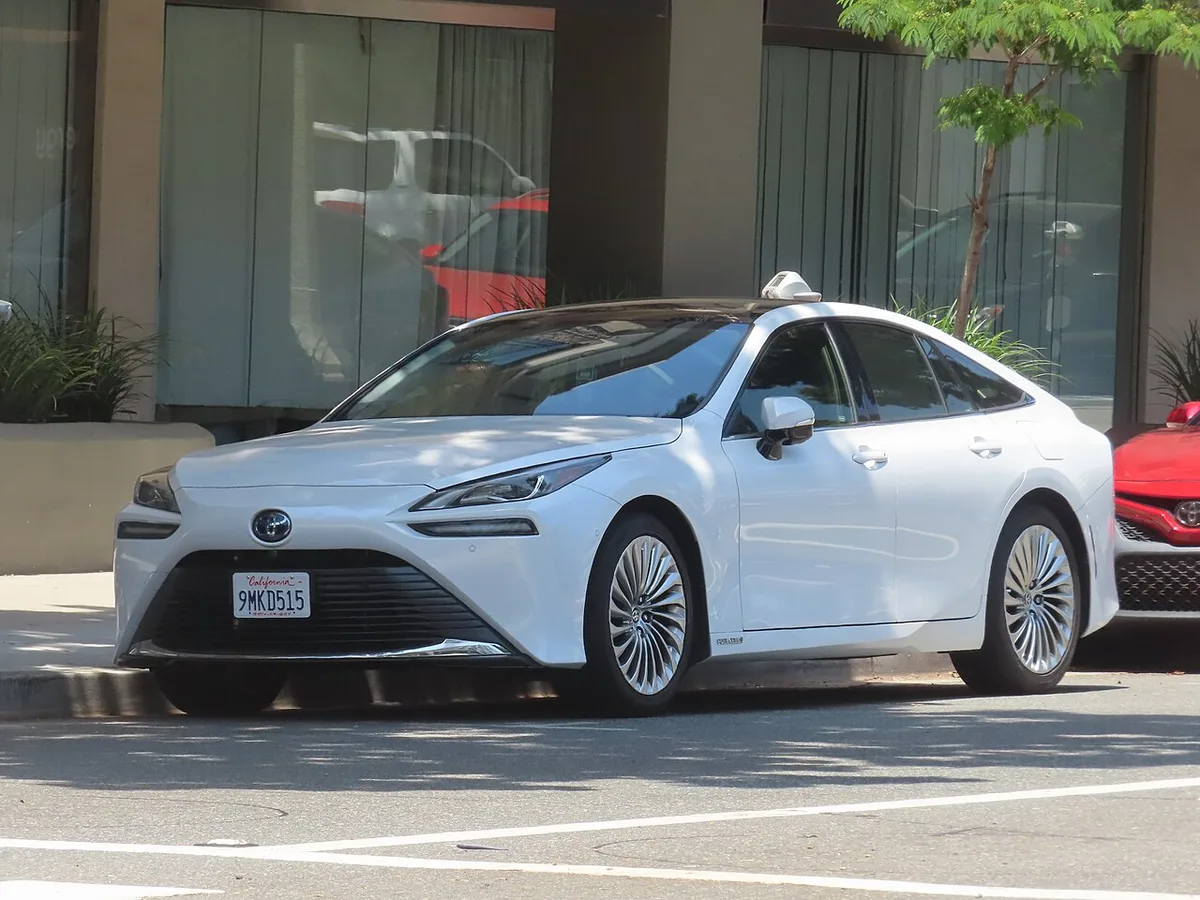
The Toyota Mirai is an electric car that makes its own electricity. A fuel cell stack under the hood combines hydrogen from the car's tanks with oxygen from the air. The reaction produces electric current and water, and the water drips out of a vent under the car. Toyota calls it a "plug-less" electric vehicle. Inside the stack, hydrogen passes over an anode and oxygen over a cathode, with a membrane between them. The hydrogen splits into protons and electrons. The protons cross the membrane, while the electrons travel through a circuit, and that flow is the current. On the far side, protons, electrons, and oxygen join to form water. Toyota says there are no other byproducts.
A lithium-ion battery stores extra power from the stack and from regenerative braking. Toyota says normal starts use battery power, then the car shifts to the fuel cell once it's cruising. Either way, one AC synchronous motor turns the rear wheels through a fixed gear ratio. The second-generation Mirai went on sale in December 2020 as a 2021 model. Its stack still runs at 650 volts, but Toyota says it's about 20 percent smaller and 50 percent lighter than the first car's stack. Output rose from 114 kW to 128 kW, so the car makes 182 hp and 221 lb-ft, up from 151 hp and 247 lb-ft.
That smaller stack explains how the car looks. The first Mirai, launched in Japan on December 15, 2014, was front-wheel drive with four seats, and its larger stack sat under a raised section of the cabin floor. Its weight split was 58:42, front to rear.
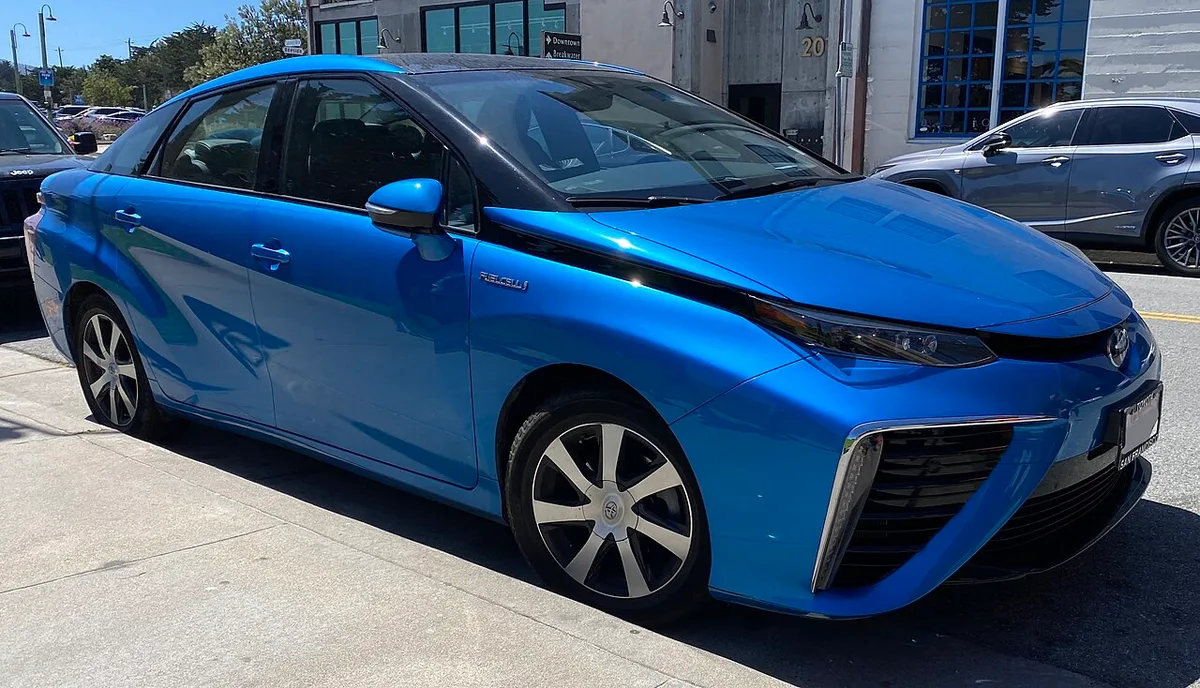
The new stack fits under the hood, and Toyota says that's what allowed the switch to rear-wheel drive. The car moved to Toyota's GA-L platform, which also sits under the Lexus LS (the LS uses a larger version). Weight distribution is now close to 50:50. The body is lower, longer, and wider, with five seats, a long hood, a sweeping roofline, a short rear deck, and a 0.29 drag coefficient. Toyota describes the look as coupe-inspired, in a four-door sedan package.
Tanks, range, and the five-minute fill
The hydrogen rides in three carbon-fiber-reinforced tanks. One runs lengthwise down the center of the car, one sits crosswise under the rear seat, and the third sits below the battery. Toyota's US release rates them at 10,000 psi and says they hold about 11 pounds of hydrogen. Toyota's global launch release lists 5.6 kg instead, which is closer to 12.3 pounds, up from 4.6 kg in the first car. Toyota rated the first Mirai's tanks at 70 MPa, or about 700 bar, and California's car pumps are listed at 700 bar.
The EPA rates the 2021 Mirai XLE at 402 miles and the Limited at 357 miles. The first-generation 2016 Mirai was rated at 312. The XLE uses 1.4 kg of hydrogen per 100 miles, so 5.6 kg works out to about 400 miles. The 2026 Mirai, now sold in one trim, is also rated at 402 miles. Toyota says a fill takes about five minutes. On August 23 and 24, 2021, hypermiler Wayne Gerdes and co-pilot Bob Winger drove a Mirai 845 miles around Southern California on one fill. They used 5.65 kg of hydrogen and set a Guinness World Records title.
Sales, stations, and resale
Toyota's own sales reports show how small the market has become. US Mirai sales fell from 2,737 in 2023 to 499 in 2024 and 210 in 2025. Through September 2026, Toyota sold 212, which already beats all of 2025. The 2026 Mirai lists at $51,795 plus a $1,195 dealer processing fee. Toyota includes $15,000 of hydrogen, capped at six years for buyers or three years for lessees, whichever comes first.
Where you can use that card is the bigger catch. Toyota said in 2020 that the new Mirai would initially be sold only in California, and its launch release cited federal data showing 43 open stations there. On October 14, 2026, that same source, the Department of Energy's Alternative Fuels Data Center, listed 42 open public hydrogen stations in California and 44 nationwide. Shell permanently closed all seven of its California car stations in February 2024. The California Air Resources Board counted 61 stations on August 29, 2025, but only 50 were open for retail sales. Eleven were temporarily out of service, and two older stations, at UC Irvine and Santa Monica, were closed because of high repair and maintenance costs. Its report also found 291 fewer fuel cell cars registered in the state than a year earlier, the first drop on record. In March 2026, Hydrogen Insight reported that more than half of California's stations were offline after supply had been disrupted for over a month.
Used prices show the damage. iSeeCars estimates a new Mirai loses 52.9 percent of its value in five years, against 40 percent for the average sedan. Real listings look worse. Jalopnik noted in June 2026 that a 2021 Mirai XLE started around $49,500 and now sells in the $10,000 range, about an 80 percent drop.
See how the Mirai's coupe-style shape scores against other sedans on WhipJury.
Sources:
How the fuel cell works, the stack, output, tank layout and pressure, the five-minute fill, the GA-L platform, the design, the first Mirai's layout, and the 43 stations in 2020: Toyota
The 5.6 kg and 4.6 kg hydrogen capacities: Toyota
The first Mirai's launch date and 70 MPa tanks: Toyota
The 2026 price, range, fuel card, and "plug-less" description: Toyota
EPA range ratings: fueleconomy.gov
Hydrogen use per 100 miles: fueleconomy.gov
The 845-mile record: Toyota
US sales for 2023 and 2024: Toyota
US sales for 2025: Toyota
US sales through September 2026: Toyota
Station counts and pump pressures in October 2026: Alternative Fuels Data Center
Shell's station closures: InsideEVs
The 2025 station status, closures, and registration decline: California Air Resources Board
The 2026 supply disruption: Hydrogen Insight
Five-year depreciation: iSeeCars
Used 2021 Mirai prices: Jalopnik
Photos via Wikimedia Commons: Jason Lawrence (CC BY 4.0), Cutlass (CC0)
Frequently Asked Questions

Cam Walsh has been obsessing over cars since before he could drive one. Based out of Atlanta, Cam covers automotive design, car culture, and the eternal debate over which whips actually look the part.