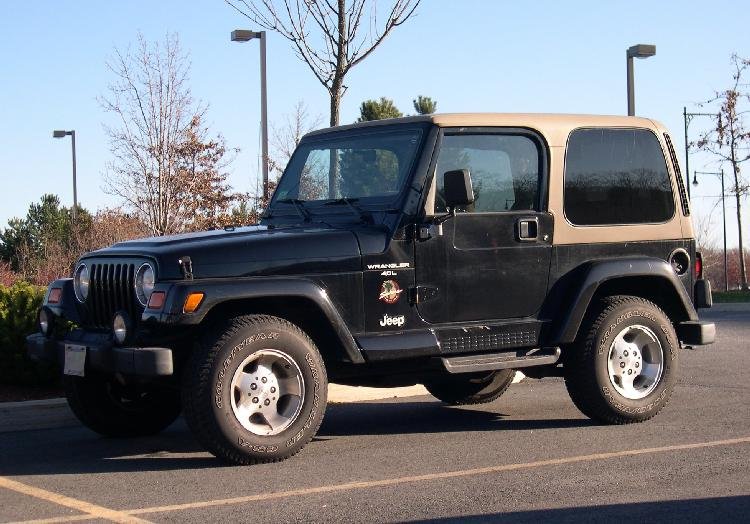
What is 4WD?
4WD, or four-wheel drive, is traditionally a part-time, driver-selectable system on trucks and off-road vehicles that uses a transfer case with high and low range to send power to all four wheels.
Four-wheel drive, or 4WD, traditionally refers to a part-time system found on body-on-frame trucks and dedicated off-road vehicles. In its normal driving mode, power goes only to the rear wheels, and the driver manually engages a transfer case to route power to the front axle as well when extra traction is needed, such as on gravel, mud, sand, or snow. The transfer case typically offers a high range for slippery but reasonably fast driving and a low range that multiplies torque significantly for slow, technical off-road work like rock crawling or steep grades. Many 4WD systems also include locking differentials that force both wheels on an axle to spin at the same speed for maximum traction in extreme conditions.
Engaging 4WD is usually described by drive mode: 2H is rear-wheel drive only, 4H locks the front and rear driveshafts together for four-wheel traction at normal speeds, and 4L does the same but through a lower gear reduction for maximum torque at low speed. Because 4H mechanically locks the front and rear axles to spin at the same average speed, it should not be used on dry pavement. Turning a corner requires the front and rear wheels to travel different distances, and on high-grip dry asphalt the driveline cannot slip enough to accommodate that difference, causing binding, drivetrain stress, and unpredictable handling, sometimes called wind-up.
4WD differs from all-wheel drive (AWD) in both intent and mechanism. Classic part-time 4WD is built for maximum low-speed torque and traction in off-road conditions and generally must be manually switched on and off. Full-time AWD systems, by contrast, are designed to operate continuously on any surface, including dry pavement, using a center differential, viscous coupling, or electronic clutch pack that allows front and rear wheels to rotate at different speeds. Some modern trucks blur this line with an "auto 4WD" mode that behaves more like AWD, but traditional 4WD remains fundamentally a part-time, off-road-oriented system.