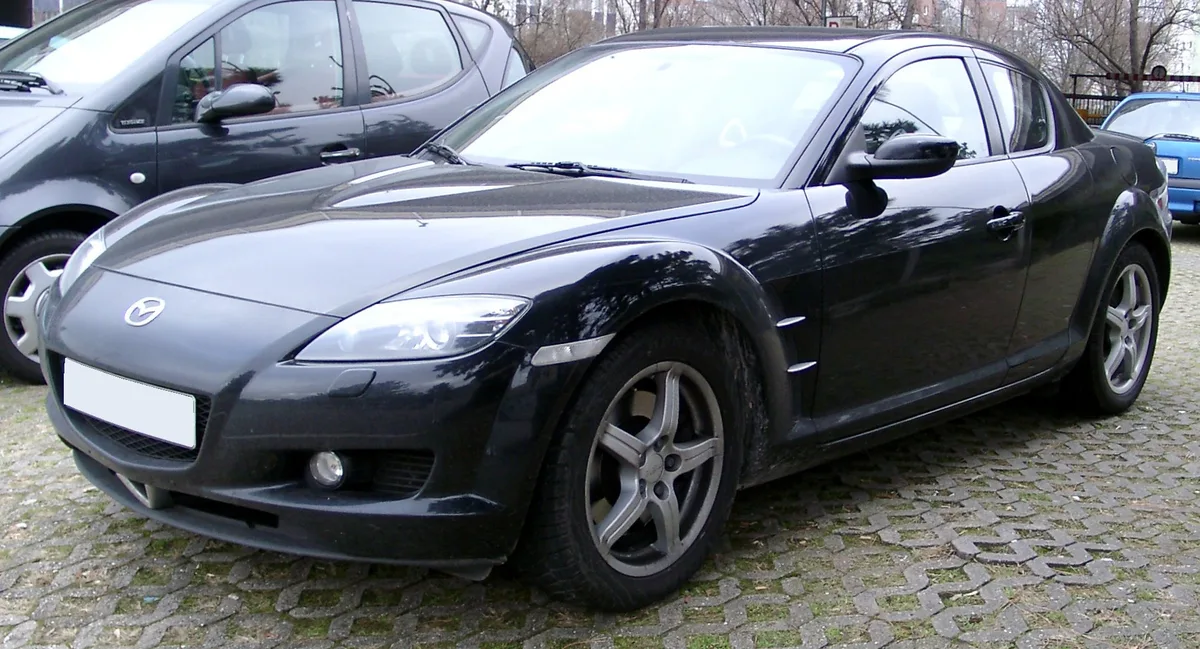
The Mazda RX-8 went on sale in 2003 and production ended in June 2012. In that time Mazda built 192,094 of them, and it remains the strangest sports car any mainstream company has sold in the last 25 years. It had a rotary engine, four seats, and rear-hinged back doors, and nobody has tried the combination since.
The doors and the packaging
Mazda called them freestyle doors. The rear pair is hinged at the back and opens against the fronts, with no B-pillar between them, so the whole side of the car opens up. You cannot open the rear doors until the fronts are open. The point was to make a genuine four-seater that still looked like a coupe. From the side it reads as a two-door, because the rear door handles are hidden inside the door apertures, so the RX-8 gets adult rear seats without the long, obvious rear door that would wreck the proportions.
It works because the rotary engine is physically tiny. Mazda could mount it low and far back, which freed up the cabin space that made four seats possible in a car this size.
The engine that ended it
The Renesis twin-rotor made between 189 and 238 hp depending on version and market, and it revved to 9,000 rpm. A rotary engine has no pistons stopping and reversing, which is how it spins that hard and why it sounds like nothing else. The same design killed the car. Rotaries burn oil by design, struggle with fuel economy, and produce emissions that became impossible to certify. The RX-8 failed to meet tightening European emissions standards, which pushed it out of that market, and falling sales finished the job. The decline was steep. Its best year was 2004, with 23,690 sold, and it never got close again.
Why it is worth knowing now
The RX-8 is cheap, and that cuts both ways. Buying one means accepting that the engine is a consumable, that it wants oil, and that a rebuild is a realistic part of ownership rather than a disaster.
What you get is a naturally balanced rear-drive chassis, a 9,000 rpm engine, and a shape that has aged quietly well. The RX-7 before it is the prettier car and now costs many times more, which makes the RX-8 the affordable way into the rotary story.
Sources:
Production run, total built, and Renesis output: Wikipedia, Mazda RX-8
Emissions and sales pressure behind the discontinuation: SlashGear
Frequently Asked Questions

Cam Walsh has been obsessing over cars since before he could drive one. Based out of Atlanta, Cam covers automotive design, car culture, and the eternal debate over which whips actually look the part.