DuelsLeaderboardGarageBlogCarsGlossaryBrowse

Toyota Supra MK4

Toyota
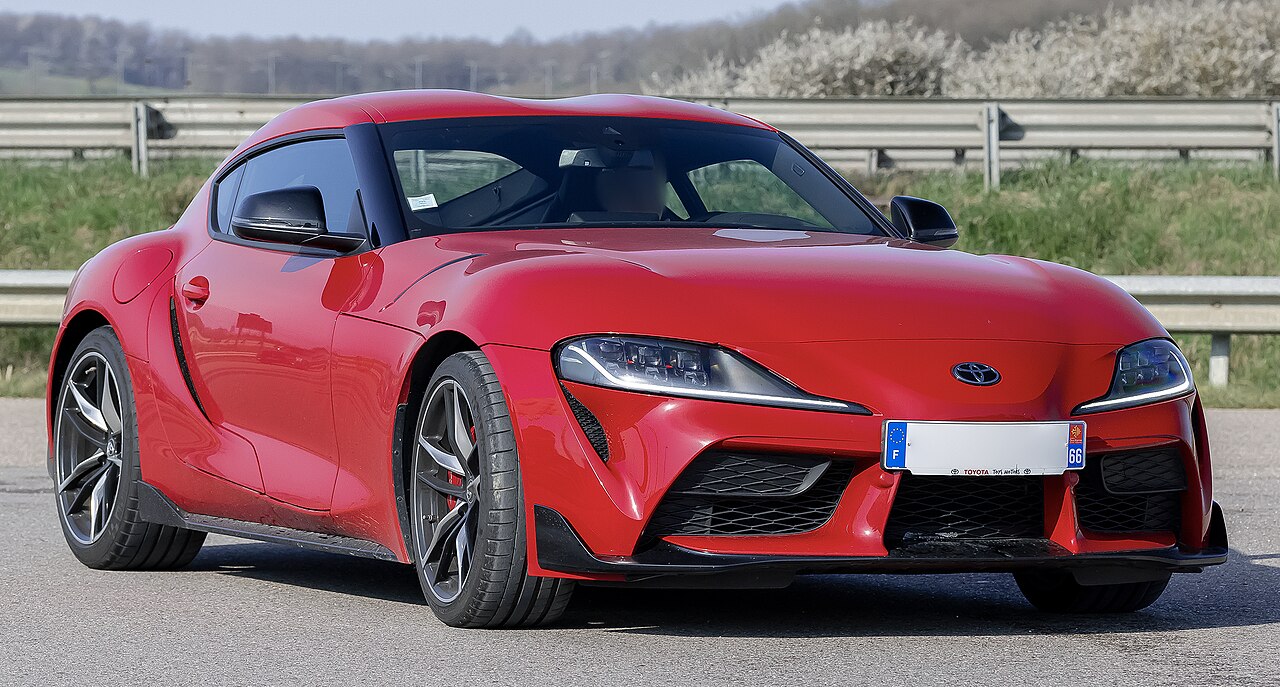
Toyota Supra MK4: The A80 Supra Turbo. 2JZ-GTE inline six, hand-built reliability, and a legacy as one of the most modified cars
Photo: Alexandre Prevot from Nancy, France / Wikimedia Commons · CC BY-SA 2.0

The A80 Supra Turbo. 2JZ-GTE inline six, hand-built reliability, and a legacy as one of the most modified cars in tuner history.

The Toyota Supra MK4 (chassis code A80) was produced from 1993 to 2002 and is the most legendary Supra variant. The car was developed under code name 0810 with goals of competing directly with the Mitsubishi 3000GT VR4, Nissan 300ZX Twin Turbo, and Mazda RX-7. The MK4 Supra became the benchmark Japanese performance car of the 1990s, particularly in turbocharged form. The MK4 Supra came in two main engine variants. The naturally aspirated 2JZ-GE made 220 horsepower; the twin-turbo 2JZ-GTE made 320 horsepower factory rating (likely more in reality). The chassis was designed with significant attention to weight distribution, suspension geometry, and aerodynamic stability. The MK4 was the first Toyota to use multi-link suspension all around. Six-speed manual or four-speed automatic transmissions were available. The MK4 Supra became a cultural phenomenon through several avenues. The Fast and Furious original film (1994) prominently featured a MK4 Supra Turbo, igniting global recognition. The 2JZ-GTE engine became one of the most respected production engines ever made, with over-engineered internals that handle 800+ horsepower on stock blocks. The chassis became the foundation for countless drag racing builds, time attack cars, and street tuner projects. Production ended in 2002. Toyota did not produce a successor for 17 years until the A90 (MK5) Supra launched in 2019. The MK4 Supra has consistently been one of the most-modified, most-discussed Japanese cars in the global tuner community. On WhipJury, A80 Supra submissions are particularly active. Stock examples (particularly clean Turbo cars) reliably top voting. Modified examples (with built engines, large turbos, suspension upgrades) are common. Drag racing builds, time attack cars, and OEM-plus restorations all find strong support.

The 2JZ-GTE

The twin-turbocharged 2JZ-GTE is one of the most respected production engines ever made. Iron block, closed-deck head, oversized rotating assembly, and twin sequential turbochargers in factory form. The engine makes 320 horsepower in stock factory specification, but the architecture supports 800+ horsepower on stock internals with appropriate supporting modifications. Built motors with race fuel can exceed 1,500 horsepower.

Engine variants

2JZ-GE (naturally aspirated). 220 horsepower. The base Supra. Targeted at less-aggressive buyers who wanted Supra style without turbo complexity.

2JZ-GTE (twin turbo). 320 horsepower factory rating. The legendary engine. Famous for handling huge power on stock internals.

MK4 Supra on WhipJury

Stock factory turbo examples reliably command attention. Drag racing builds with large single turbos, big-displacement built motors, and chassis modifications are common. Time attack and circuit-prepped builds appear regularly. The community recognizes the MK4 Supra as one of the seminal Japanese performance cars and votes accordingly.
Frequently asked questions about Toyota Supra MK4

How much horsepower can a stock 2JZ-GTE handle?
With proper supporting modifications, 600-800 horsepower on stock internals is routine. With larger turbos and supporting hardware, 800-1,000 horsepower on stock blocks is common. With race fuel and proper tuning, 1,200+ horsepower on stock blocks has been documented. The factory engine is famously over-engineered for the 320 horsepower factory rating.
Are MK4 Supras hard to find?
Yes, particularly clean examples. Production was around 11,000 cars total, with most going to JDM markets. North American Supra Turbo production was around 1,500 cars. Surviving low-mile turbo cars are rare and commanding premium prices. JDM imports have grown the available pool but not enough to satisfy demand.
Why is the MK4 Supra so valuable?
Multiple factors. Limited production (especially turbo variants). The legendary 2JZ-GTE engine that supports massive power on stock blocks. Cultural significance through Fast and Furious. Strong engineering reputation. Continued community appreciation. The combination has driven prices to levels comparable to many supercars from the same era.
Is the MK4 Supra reliable?
Generally yes. The 2JZ-GTE is durable when maintained properly. Common issues are timing belt service (recommended every 60,000-90,000 miles), turbo wear at higher mileage, and various age-related items. Many MK4 Supras have crossed 200,000 miles on stock engines. The platform's reputation for reliability is part of its legendary status.
How does MK4 Supra compare to A90 Supra?
Different cars. The A80 (MK4) used the 2JZ-GTE inline six and Toyota chassis. The A90 (MK5) uses the BMW B58 inline six on a BMW Z4 platform. The A80 has more cultural significance and tuning potential; the A90 is more refined and modern. The A80 is the legendary one; the A90 is the worthy continuation.

More on the Toyota Supra MK4

Why a V8 rumbles and a Ferrari screams

An American V8 rumbles and a Ferrari V8 screams because of the crankshaft. Cross-plane cranks fire unevenly between banks and produce the lopey rumble; flat-plane cranks alternate perfectly and rev higher for that howl. Here's also why an inline-six is the smoothest engine you can buy.

1JZ vs 2JZ: What's the Difference and Which One Should You Swap?

The 1JZ and 2JZ are both Toyota inline-six engines from the same family, and people use the names like they are interchangeable. They are not. The 1JZ is a 2.5-liter that loves to rev. The 2JZ is a 3.0-liter that became famous for surviving four-figure horsepower on stock parts. Which one you want depends entirely on what you are building.

What Does JDM Actually Mean?

JDM stands for Japanese Domestic Market: vehicles and parts built for sale in Japan, to Japanese specifications, for Japanese buyers. A car is JDM because of where it was sold, not where it was made, which means the term gets misused constantly. The Civic your neighbor bought at an American Honda dealer is a Japanese car, but it is not a JDM car.

Other Toyota models

2000GT4Runner86AE86AltezzaAvalonbZ4XCamryCelicaCelica GT-FourCenturyChaser
More Toyota models