Jaguar C-Type
Jaguar
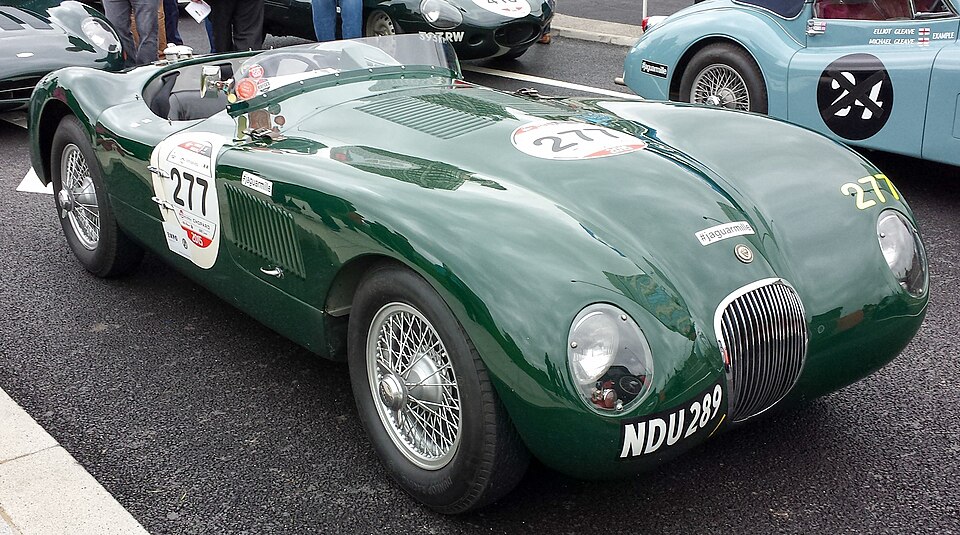
Photo: DeFacto / Wikimedia Commons · CC BY-SA 4.0
Le Mans winner of 1951 and 1953. Pioneered disc brakes in racing. The car that started Jaguar Le Mans legend.
The Jaguar C-Type is the racing car that launched Jaguar Le Mans legend, winning the 24 Hours in 1951 and again in 1953. It paired a tuned XK inline-six with a lightweight tubular frame and aerodynamic body, and the 1953 cars famously used disc brakes, a major competitive advantage that changed racing. It paved the way for the dominant D-Type. On WhipJury, the C-Type is a revered piece of early-1950s motorsport history.
C-Type significance
Tuned XK 3.4 liter inline-six. Lightweight tubular frame with aerodynamic aluminum body. Le Mans wins in 1951 and 1953. The 1953 cars pioneered Dunlop disc brakes in top-level racing, a decisive advantage.
Frequently asked questions about Jaguar C-Type
When did the C-Type win Le Mans?
In 1951 and again in 1953. These wins established Jaguar as a force at Le Mans and set the stage for the D-Type.
Did the C-Type pioneer disc brakes?
Yes. The 1953 Le Mans-winning C-Types used Dunlop disc brakes, a significant competitive advantage that helped change racing braking technology.
What engine does the C-Type use?
A tuned version of the XK 3.4 liter inline-six, the same engine family that powered the road-going XK120 and later the D-Type and E-Type.
Is the C-Type valuable?
Yes, very. As an early-1950s Le Mans winner with few survivors, it is among the most valuable classic Jaguars, selling for many millions.
What is the difference between C-Type and D-Type?
The C-Type (1951-1953) came first with a tubular frame; the later D-Type used advanced monocoque construction and won Le Mans three times. Both used the XK six.
Other Jaguar models
Submit Your Whip