What is Burnout?
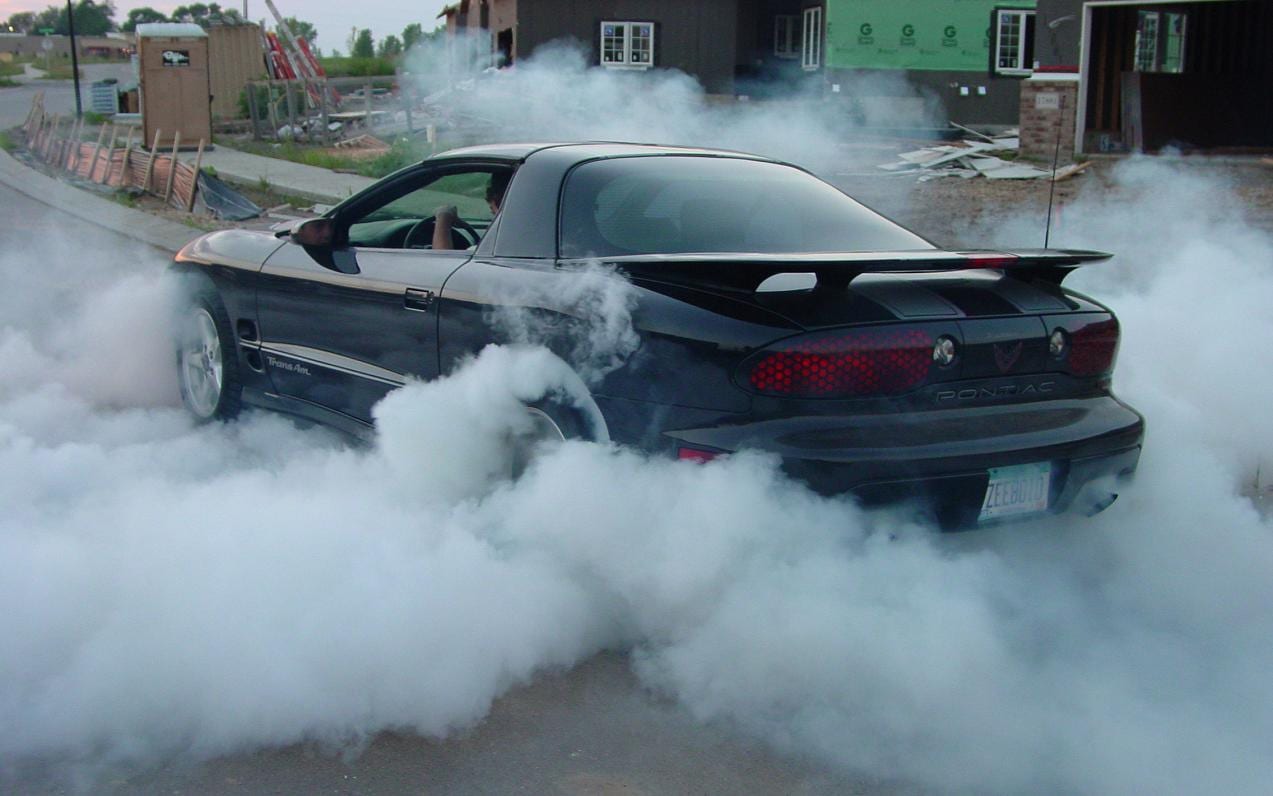
Spinning a car's drive wheels while holding it in place, so the tires heat up and smoke.
A burnout, also called a peel out, power brake, or brakestand, means holding a car still while its driven wheels spin, until friction makes the tires heat up and smoke. It comes from drag racing, where it has a real job: slicks grip better hot, and a burnout is the quickest way to heat them right before a run. It also cleans debris off the tires and lays rubber on the starting line for traction.
The practice traces back to Ted Edwards Drag Strip in Fairburn, Georgia, in the mid-1960s, where Buddy Houston, his brother Melson, and David Tatum II used water and bleach to break their tires loose. It spread to California, where drag racing was better organized. Tracks still use a wet "water box," once called a "bleach box," to start burnouts. The first NHRA burnout came in 1969 at the Hot Rod Magazine Championship Drag Races in Riverside, California, and Don Garlits was the first to do burnouts across the starting line.
In a RWD car, the driver works the gas and brake together so the front brakes hold the car while the rear tires spin, and a line lock makes it easier by holding only the front brakes. Front-drive cars use the parking brake to lock the rear wheels, and all-wheel-drive cars are the hardest because all four tires have to break loose. Burnout contests, judged on crowd response, are especially popular in Australia, and NASCAR winners often do one to celebrate. On public roads they're illegal in most countries. In New South Wales, police can confiscate the car for three months on a first offense.