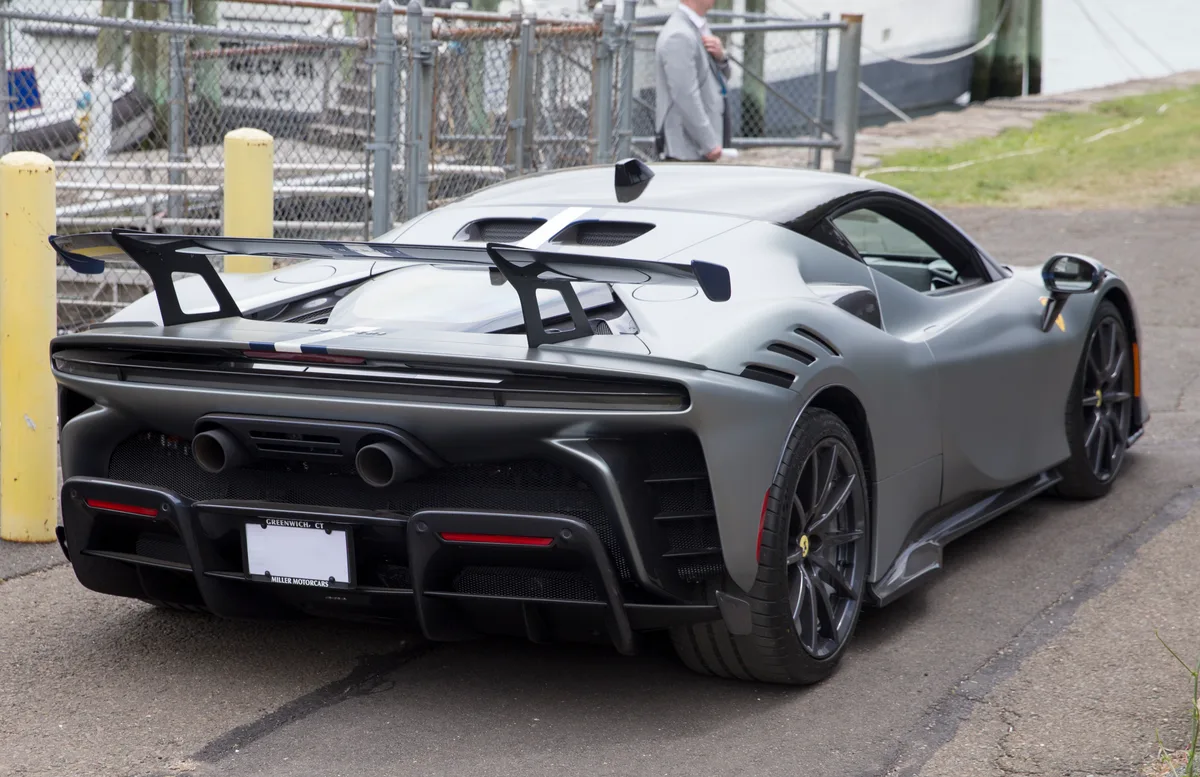
Ferrari has filed a patent for taillights that move. Not for show, and not to look futuristic. The idea is that the rear light bar swings out of its normal position below the rear wing and up behind it, opening a path for air and effectively making the wing longer when the car needs more grip at the back.
It's a small, strange detail, and it points at something Ferrari has been fighting for years: modern aerodynamics keeps trying to make beautiful cars ugly.
What the Patent Actually Describes
The filing covers a rear light assembly mounted so it can move relative to the wing or spoiler. In its resting position it sits below the main wing, looking like an ordinary light bar. When the car wants to shift aerodynamic load rearward, the assembly moves out of the way and sits behind the wing instead. That does two jobs at once, clearing the airflow through the back of the car and adding a little more working surface to the wing, which means more downforce.
Ferrari sketched it on more than one body style, including a version for the Purosangue where the light assembly rotates back and up past the trailing edge of the wing.
Worth being clear about what this is, though. It's a patent, not a product. Manufacturers file these constantly to protect an idea, and plenty of them never reach a road car. Nobody has said this is going into production, so treat it as a look at how Ferrari is thinking rather than a preview of a specific model.
Why This Is Really a Design Problem
Here's the part that matters if you care how cars look. Active aero usually means bolting on things that move: flaps, deployable wings, extra surfaces. All of it works, and almost none of it is pretty. The faster a car needs to go, the more the engineers want to hang off the back of it, and the more the designers lose the clean shape they started with.
What this patent does is sneaky in the best way. Instead of adding another moving panel, it takes a part that has to exist anyway, the taillight, and makes it do aerodynamic work. The car gets the function without gaining a single new visible appendage. That's not an engineering trick so much as a styling defense, a way to keep a Ferrari looking like a Ferrari while still generating the numbers.
It fits how the brand has always operated. Ferrari has spent decades hiding its aero in the surfaces themselves rather than strapping hardware on top, and cars like the SF90 and 296 already bury a lot of clever airflow work in shapes that read as pure styling. A moving taillight is just the next place to hide it.
The hypercar world has largely accepted that huge wings are the price of performance. Ferrari clearly hasn't, and a patent like this is the argument that you shouldn't have to pick.
So put a wing-less Ferrari against something bristling with aero on WhipJury and see which approach the crowd actually rewards.
Sources:
The patent filing and how the moving light works: Motor1
The Purosangue interpretation and production caveat: CarBuzz
Ferrari's wider active-aero patent work: Carscoops
Frequently Asked Questions

Jeffrey Wiley has spent more time than he'd like to admit thinking about what makes a car look right. He writes about automotive design, car culture, and the opinions people have strong feelings about. He lives in north Georgia.