Studebaker Avanti
Classic · Studebaker
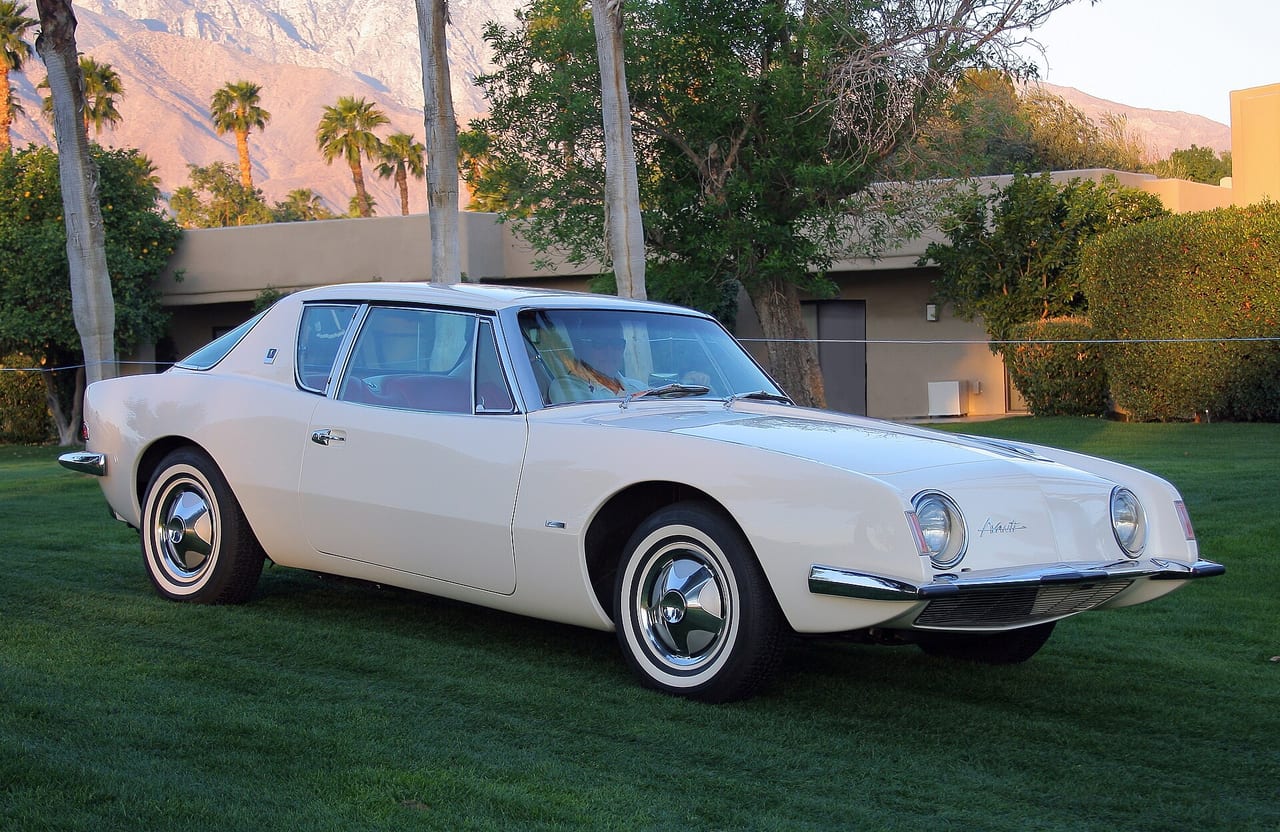
Studebaker Avanti: The Fiberglass Coupe Studebaker Built in Its Last Years
The Studebaker Avanti is a four-seat personal luxury coupe with a fiberglass body, built from June 1962 to December 1963 and designed by Raymond Loewy's team in about five weeks. A supercharged version set 29 speed records at the Bonneville Salt Flats.
Sherwood Egbert became Studebaker's president in February 1961 and asked Raymond Loewy for a new sports car the next month. Loewy's team of Tom Kellogg, Bob Andrews, and John Ebstein worked in a rented house in Palm Springs and sent a scale model to South Bend in about five weeks. Loewy wanted no grille, a "coke bottle" waist, and a fastback-style tail, so the Avanti takes air from under the bumper instead. The body was fiberglass on a modified Lark convertible chassis, at first molded by the company that made the early Corvette's panels, and the car got Bendix-built front disc brakes, which Wikipedia calls a first for an American production car. The name is Italian for "forward."
Every Avanti used Studebaker's 289 cubic inch V8. The R1 made 240 hp, the supercharged R2 made close to 290 hp, and only nine cars got the 335 hp R3 tuned by Andy Granatelli. Road & Track timed an R2 from 0 to 60 mph in 7.3 seconds. A modified R3 car set 29 records at Bonneville, including a flying mile at an average of 168.15 mph, and Granatelli later ran an experimental twin-supercharged Avanti at 196 mph.
Egbert hoped to sell 20,000 Avantis in 1962, but Studebaker could build only about 1,200 that year, and Studebaker built 4,643 in all before South Bend closed in December 1963. The base price was $4,445, a little more than a Corvette Sting Ray coupe. The car didn't die with Studebaker. A group of South Bend dealers bought the rights and tooling and sold the Avanti II with Chevrolet V8s from 1965, and later owners built Avantis in small numbers until 2006.