Photo: Unknown / Wikimedia Commons · CC BY-SA 3.0
What is Power Band?
The power band is the RPM range in which an engine produces most of its usable power and torque, and its width shapes how a car feels to drive and how it should be geared and shifted.
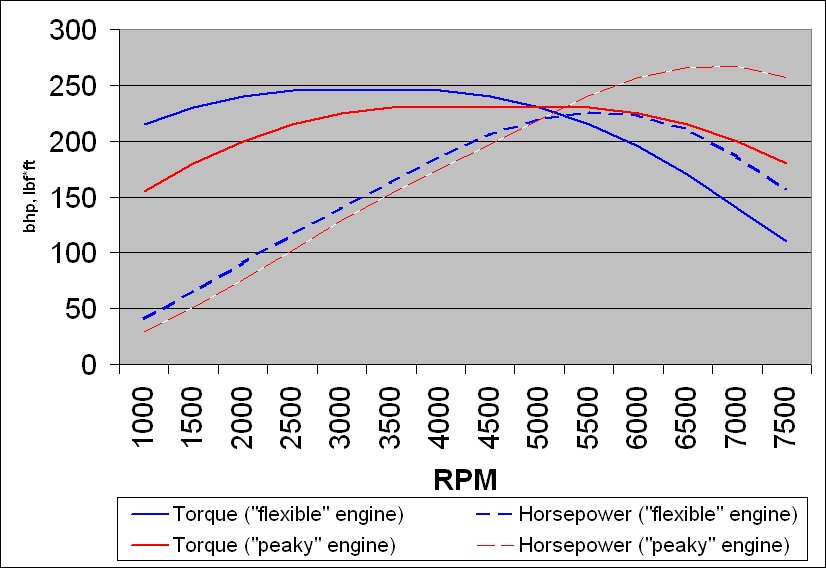
Every engine's torque and horsepower output varies across its rev range, rising from idle, peaking somewhere in the middle to upper RPM band, then falling off again near redline. The power band refers to the stretch of RPM where that output stays close to its peak and the engine feels genuinely strong, as opposed to the ranges above and below it where the engine feels flat or sluggish. Drivers and tuners care about a power band because knowing where it sits tells you how an engine wants to be driven and shifted.
Related terms
Frequently asked questions
What is a narrow versus a wide power band?
A narrow power band means output peaks sharply over a small RPM window, common in high-strung, high-revving engines like small-displacement naturally aspirated units or peaky turbo motors, requiring frequent shifting to stay in the sweet spot. A wide power band spreads strong output across a broad RPM range, common in large-displacement or torque-focused engines, making the car feel strong almost anywhere in the rev range.
How does camshaft design affect the power band?
Camshaft profile controls how long and how far the intake and exhaust valves open, which shapes how well the engine breathes at different RPMs. Aggressive, high-lift, long-duration cams favor high-RPM airflow and push the power band higher, while milder cam profiles favor low-RPM torque and produce a broader, lower power band.
Why do turbocharged engines often feel like they have a narrower power band than naturally aspirated ones?
Turbo lag means boost, and the extra power it brings, only fully arrives once the turbine spools up to a certain RPM, which can create a noticeable step in power delivery. Modern twin-scroll and smaller turbos reduce this effect, but older or larger turbo setups can still feel like the real power band starts abruptly partway through the rev range.
How does the power band affect gear ratio choice?
Gearing is chosen so that shifting between gears keeps the engine within its power band as much as possible. A narrow power band typically calls for closely stacked gear ratios so the engine does not fall out of its strong RPM range after each shift, while a wide power band allows wider ratio spacing.
Where do horsepower and torque peaks sit relative to the power band?
Torque typically peaks earlier in the rev range and horsepower peaks later, since horsepower is a function of torque multiplied by RPM. The power band generally spans from somewhere near the torque peak up through the horsepower peak, which is why drivers are often told to shift near the power peak for maximum acceleration.