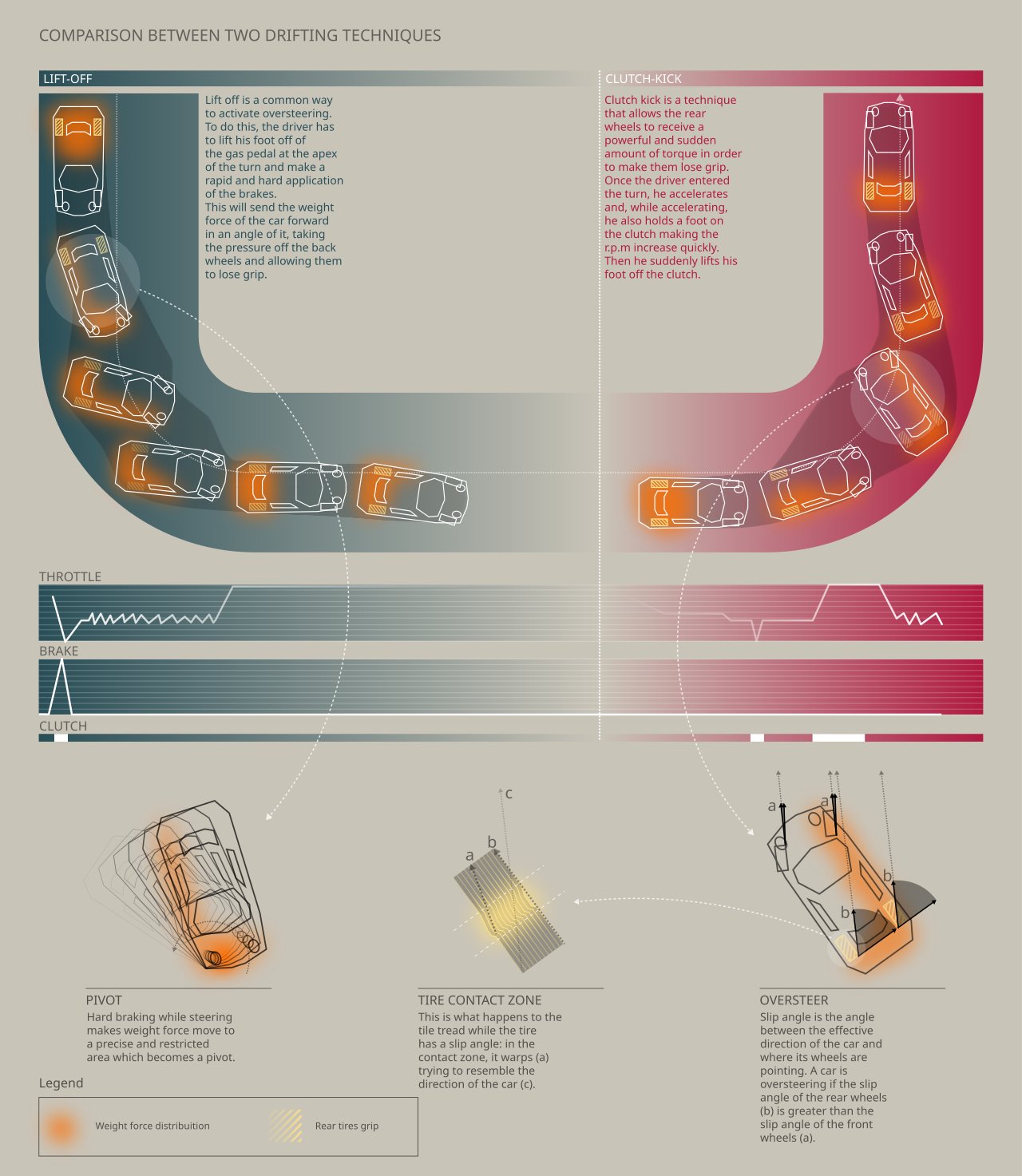
What is Clutch Kick?
A drift initiation technique where the driver rapidly depresses and releases the clutch to spike engine RPM and send a sudden torque pulse to the rear wheels, breaking traction to start a slide.
A clutch kick is a technique used primarily in drifting to initiate or maintain a sideways slide. The driver blips the throttle to raise engine RPM while simultaneously pressing the clutch to disconnect the drivetrain. The clutch is then released rapidly, sending a sudden spike of engine torque to the rear wheels. The inertia of the vehicle's momentum combined with the sudden torque burst breaks rear wheel traction, causing the rear of the car to step out into oversteer. The driver then catches the slide with opposite lock.
Clutch kicking is most effective on rear-wheel-drive cars with limited-slip differentials and relatively high-torque engines. The technique is widely used in Formula D and competitive drifting to initiate transitions (changing the direction of the slide quickly) or to add angle in situations where the car is not sideways enough. For competition drifting, clutch kicks are executed at specific moments dictated by the course and judging criteria.
The clutch kick places significant stress on the driveline, particularly the clutch disc, pressure plate, and transmission input components. High-performance or racing clutches rated for aggressive use are recommended for builds used in regular drifting. Stock clutches wear quickly under repeated clutch kicks. The technique requires practice to time correctly; too slow a release produces a smooth engagement with less shock, while too aggressive a release risks only briefly spinning the tires or stalling.