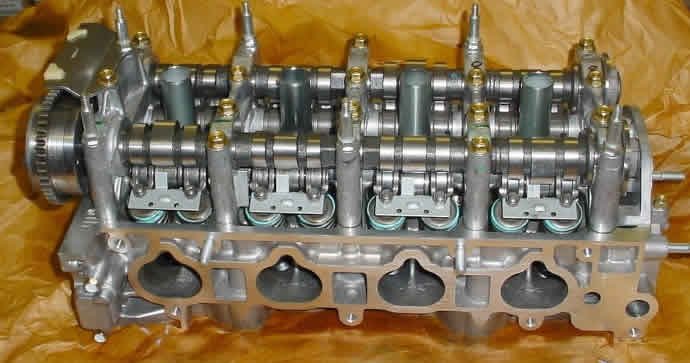
What is Variable Valve Timing?
A technology that continuously or step-changes the timing of intake and exhaust valve opening events relative to crankshaft position, broadening an engine's power and torque delivery across the RPM range.
Variable valve timing (VVT) allows an engine's camshaft(s) to be phased forward or backward relative to the crankshaft as the engine operates. By advancing or retarding cam timing under computer control, engineers can optimize the overlap between intake and exhaust valve opening events for different conditions. More overlap at high RPM and load improves power; less overlap at idle and light load improves fuel economy and idle quality.
The technology became widespread through the 1990s and 2000s. Toyota's VVT-i (Variable Valve Timing-intelligent), introduced 1996, was among the earliest mass-market implementations. BMW's VANOS, Porsche's VarioCam, Nissan's CVTC, and Ford's Ti-VCT all followed related principles. Honda's VTEC combines variable lift switching with phase control in its i-VTEC system. Most modern naturally aspirated and turbocharged engines use some form of VVT on both intake and exhaust camshafts (dual VVT).
Variable valve timing is fundamentally different from variable valve lift (like VTEC's lift-switching). Timing changes the phase of events; lift changes how far the valve opens. Premium systems like BMW's Valvetronic and Fiat's MultiAir vary both continuously. The net result across the industry has been broader torque curves, improved fuel economy, and reduced emissions without sacrificing peak power output.