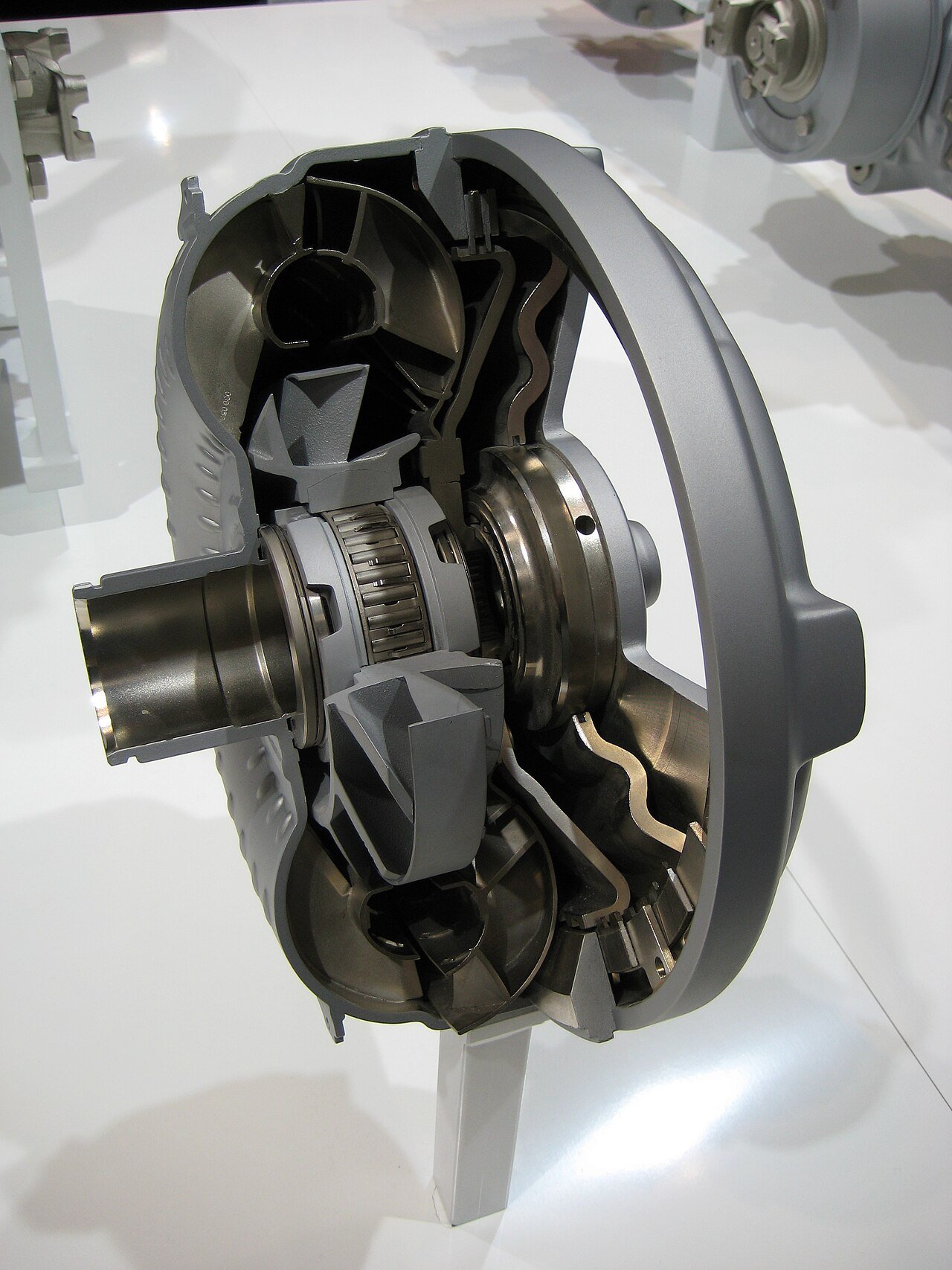
What is Torque Converter?
A torque converter is a fluid coupling that transfers power from the engine to an automatic transmission without a mechanical clutch, using spinning fluid to multiply torque at low speed.
A torque converter sits between the engine and an automatic transmission, performing the same basic job a clutch does in a manual car: connecting and disconnecting engine power from the gearbox. Instead of a mechanical friction connection, a torque converter uses transmission fluid spun by an impeller attached to the engine, which drives a turbine connected to the transmission input shaft. Because the connection is fluid rather than solid, the engine can keep running while the vehicle is stopped and in gear, and the converter allows torque to be transmitted smoothly even as engine and transmission speeds differ.
A key characteristic of a torque converter is torque multiplication: at low speeds, when the difference between impeller and turbine speed is largest, a stator inside the converter redirects returning fluid to boost the torque delivered to the transmission, similar to gearing down. This effect is strongest from a stop and diminishes as vehicle speed increases and impeller and turbine speeds converge. This is also the source of the classic automatic transmission feel of vehicle creep, where the car moves forward at idle in gear without any throttle input, since the fluid coupling still transmits some power even at idle.
Because a pure fluid coupling is inherently less efficient than a solid mechanical connection, slipping slightly and generating heat, most modern torque converters include a lockup clutch that mechanically locks the impeller and turbine together once the vehicle reaches a set speed, eliminating fluid slip and improving fuel economy and cruising efficiency. Performance-oriented transmissions, including those used in drag racing, often use torque converters tuned with a specific stall speed, the RPM at which the converter begins effectively transmitting power, chosen to match the engine's power band for the quickest launches.