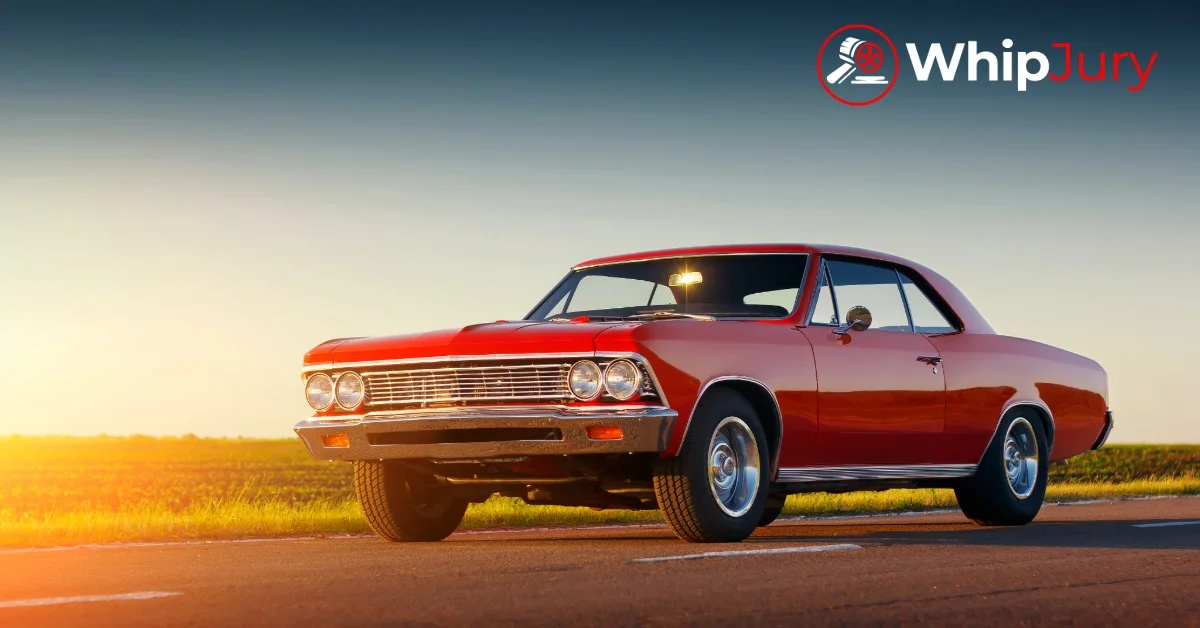
The 1969 Ford Mustang Mach 1 looks better today than it did when it was new. The 2002 Pontiac Aztek looks exactly as bad as it did in 2002, possibly worse now that the cultural context that produced it has faded. Both cars are over twenty years old. Only one of them aged. The question of why some cars improve with time and others calcify into their worst qualities is worth taking seriously because the answer tells you something about what good design actually is.
Trend-Chasing Is a Design Death Sentence
The cars that age worst are almost always the ones that were designed to look current rather than to look right. The late 1990s and early 2000s produced a specific category of design failure where manufacturers chased the jelly bean aesthetic, all rounded surfaces, no sharp lines, a bloated softness that was supposed to signal modernity and instead signaled nothing once the moment passed. The 2001 Chrysler PT Cruiser is the canonical example. It was retro-styled in a way that felt fresh in 2000 and dated by 2004. The design was built entirely on a cultural moment rather than on proportion, and when the moment ended the design had nothing underneath it to fall back on.
Contrast this with the E30 BMW 3 Series, which was designed in the early 1980s, a decade with its own strong visual culture, and somehow looks almost timeless forty years later. The E30 did not try to look like the 1980s. It tried to look like a perfectly proportioned small sports sedan, and that ambition transcended the decade it was built in.
Proportion Ages Better Than Detail
This is probably the most reliable rule in automotive design longevity. Surface details, body cladding, chrome trim treatments, headlight shapes, grille patterns. All of these respond to contemporary taste and all of them date. The underlying proportion of a car, the relationship between hood length and wheelbase, the roofline height relative to the body width, the wheel arch size relative to the overall stance. These are either right or wrong independent of what year it is.
The Ferrari 250 GTO from 1962 has proportions that would read as desirable in any decade. Strip away the period details and the shape underneath is simply correct. The 2006 Pontiac Solstice had a strong initial visual impact built on surface drama and almost no underlying proportion to support it. When the surface drama became familiar it had nowhere to go. Cars built on proportion have a floor that trend-dependent cars lack entirely.
Technology Dates Faster Than Form
Headlights are currently doing the most visible work in dating modern cars. The late 2010s produced a generation of elaborate multi-element LED headlight signatures that were genuinely impressive when new and will read as aggressively of-their-moment in fifteen years the way chrome bumpers read as aggressively of-their-moment now. The technology drives the design decision and the technology moves faster than the form.
The cars that avoid this trap tend to use technology in service of a simple graphic rather than as the feature itself. A clean horizontal light bar that happens to use LED technology will age better than a complex fractal headlight assembly that exists primarily to demonstrate that the technology exists. Simplicity is more forgiving to time than complexity in almost every design discipline and automotive lighting is no exception.
Some Cars Need Distance
A handful of cars were poorly received when new and improved dramatically once they were no longer being evaluated against their contemporaries. The original Honda Element was considered awkward and utilitarian when it launched in 2003. Two decades later the boxy honest pragmatism reads as ahead of its time and the same people who dismissed it are now buying used examples at inflated prices. The design did not change. The context around it did.
The Citroën DS went through the same process in a more dramatic way. Considered bizarre and unsettling when it appeared in 1955, it is now considered one of the greatest automotive designs of the twentieth century. Sometimes a design is so far outside its moment that it takes the moment receding before the design can be seen clearly. These cars do not age well so much as they reveal themselves slowly, which is different and rarer.
The Cars Aging Badly Right Now
It takes about ten years for a car's design to either hold or start to collapse. By that measure, several cars from the mid-2010s are currently entering their uncomfortable period. The first-generation BMW i8 looked revolutionary in 2014 and now reads as a design exercise that tried too hard to signal electric vehicle futurism at a moment when that language was still being invented. The early Tesla Model S has aged faster than expected partly because Tesla's own subsequent designs made it look transitional rather than definitive.
The cars from the same period that are holding up better are the ones that did not try to announce anything. The 2014 Mazda3. The Porsche 991 generation 911. The Range Rover Sport. Designs that were confident without being declarative are aging into themselves rather than into their moment.
The faceoff is a real-time test of where a car currently sits in this process. A design that is aging into irrelevance will start losing faceoffs it would have won five years ago. A design that is aging into itself will keep winning against newer cars that are chasing trends it never bothered with. Run the test on WhipJury and find out where your car stands right now.
Frequently Asked Questions

Cam Walsh has been obsessing over cars since before he could drive one. Based out of Atlanta, Cam covers automotive design, car culture, and the eternal debate over which whips actually look the part.