What is Twin-Scroll Turbo?
A turbocharger design that divides the exhaust housing into two separate scroll passages, pairing cylinders so exhaust pulses do not interfere with each other, improving spool speed and efficiency.
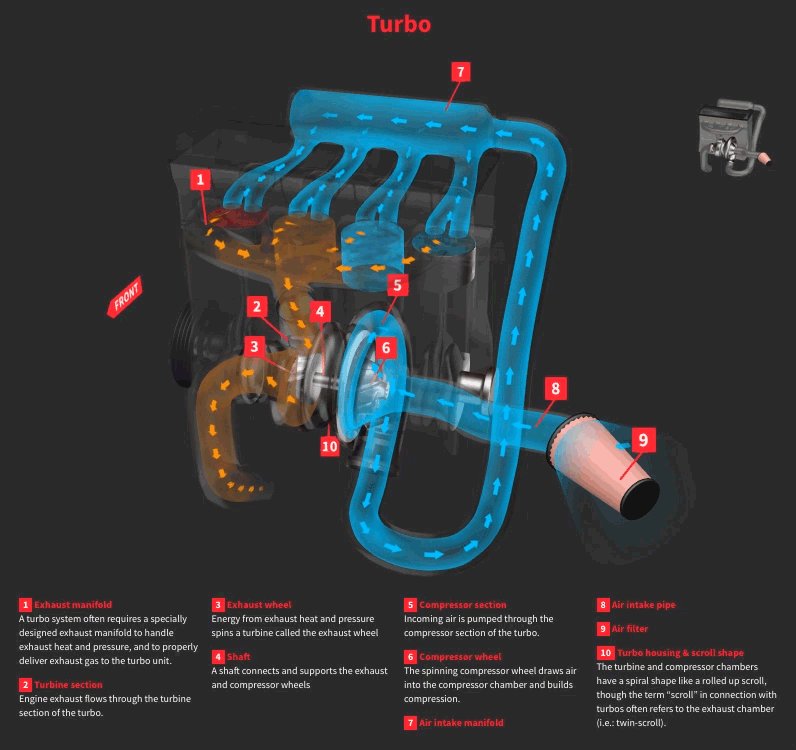
A twin-scroll turbocharger uses a divided turbine housing with two separate volutes (scrolls) that feed the turbine wheel from different sets of engine cylinders. On a four-cylinder engine, cylinders 1 and 4 (which fire far apart in the firing order) are paired together in one scroll, and cylinders 2 and 3 in the other. This separation prevents the exhaust pulse from one cylinder from interfering with the exhaust scavenging of an adjacent cylinder, a problem on single-scroll turbos when cylinders on adjacent firing events share one exhaust collector.
The result of keeping pulses separated is that each exhaust pulse arrives at the turbine wheel with more energy than on a single-scroll design. The turbine spools faster and more efficiently, especially at lower RPMs and smaller throttle openings. Twin-scroll turbos improve boost response (less turbo lag), widen the effective power band, and often allow better exhaust cam timing optimization because the scavenging of adjacent cylinders does not interfere.
BMW's N55 (and later B58) engines, Porsche's 991.2 and 992 Carrera engines, and various high-performance turbocharged four-cylinders use twin-scroll designs. Paired with twin-scroll turbos, a properly designed equal-length or paired exhaust manifold (not a traditional four-into-one, which would re-merge the pulses) is needed to realize the full benefit.