DuelsLeaderboardGarageBlogCarsGlossaryBrowse

Cal Look

Car culture term

Cal Look
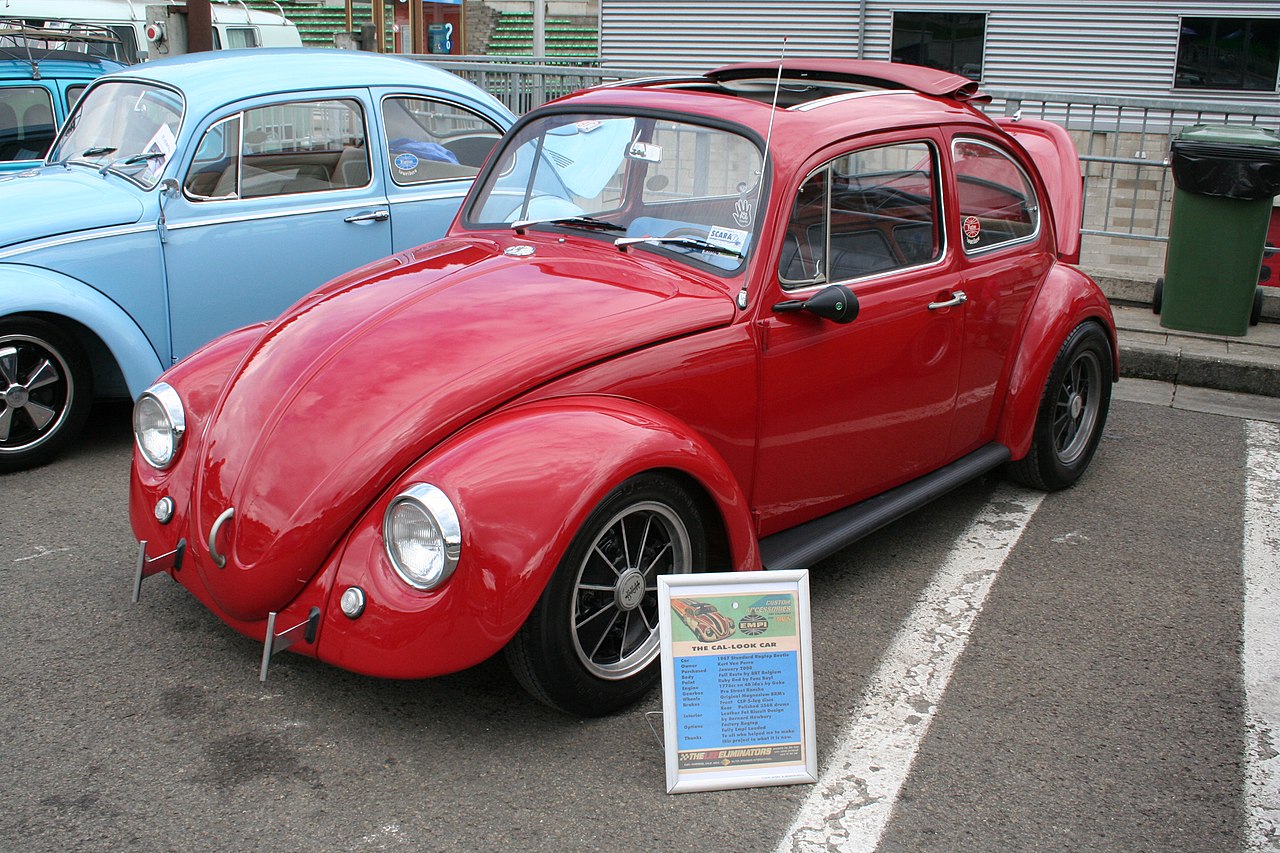
Photo: Tero virta at English Wikipedia / Wikimedia Commons · Public domain

What is Cal Look?

A 1960s and 1970s Volkswagen Beetle modification style. Lowered, fenderless or with cut fenders, with specific wheels and clean detailing. California origin.

Cal Look (California Look) is a Volkswagen Beetle modification style that emerged in California in the late 1960s and 1970s. The style is characterized by a clean, low stance with specific styling elements: removed or significantly modified front bumper, removed running boards, lowered ride height, specific wheel choices (often Empi 5-spoke or Centerline-style wheels), and clean exterior with no body kit additions.

The Cal Look style emerged from California Volkswagen drag racing and street culture. The Beetle was popular as an affordable, light, and easily modified platform. Cal Look modifications typically include performance engine work (larger displacement, dual carburetors, ported heads), drag-style suspension setups (often raised in front for weight transfer), and the distinctive minimal cosmetic approach. The aesthetic is the opposite of the German Look (which emphasizes period-correct stock appearance).

Today, Cal Look continues as a respected Volkswagen modification style with dedicated events (like the Drag Day at Lions Drag Strip in Long Beach, California). Period-correct Cal Look Beetles have appreciated significantly as the original cars age. The style influenced subsequent Volkswagen modification movements and remains a distinct cultural reference within the broader VW community.
Related terms

Hot rodStance

Frequently asked questions

What is the difference between Cal Look and German Look?
Cal Look emphasizes lowered ride height and California-derived modifications (specific wheels, removed bumpers, drag-style touches). German Look emphasizes period-correct stock appearance with subtle improvements (factory wheels, OEM-style modifications). The two styles are distinct movements within the broader Volkswagen modification community.
Why are Empi wheels associated with Cal Look?
Empi (European Motor Products Inc.) produced wheels and aftermarket parts specifically for Volkswagens in the late 1960s and 1970s. The Empi 5-spoke wheel became a defining visual element of Cal Look Beetles. Period-correct Empi wheels are still sought after for restoration projects.
Are Cal Look Beetles still relevant?
Yes. Period-correct 1960s and 1970s Cal Look Beetles are increasingly valuable as the original cars age. Modern reproductions of Empi parts and similar wheels are widely available. The style has dedicated event series and a robust online community. Cal Look represents a specific period of Volkswagen modification culture.
Did Cal Look influence other movements?
Yes. The lowered, clean aesthetic with specific wheel choices anticipated modern stance and Hellaflush culture. The minimalist approach (no body kit additions, just lowered ride and wheel choice) has been adopted by various modern modification movements. Cal Look is often cited as an early progenitor of modern stance.
Is Cal Look just for old Beetles?
The classic Cal Look style is specific to early air-cooled Beetles (typically 1950s through 1970s model years). Modern Beetle (1998-2019) and ID.Buzz applications are unusual but exist. The Cal Look philosophy (lowered, clean, period-specific) has influenced modifications of other VW models including the Karmann Ghia and original Bus.

Cal Look on the blog

Mitsuoka is turning a Miata into a 1950s Corvette

Mitsuoka's new LA1 puts 1950s C1 Corvette bodywork on a current Mazda MX-5, with quad headlights, a chrome bumper, side gills, and taillights moved to the quarter panels. It debuts November 26 as a limited Japanese-market car. The same designer did the 2018 Rock Star, which copied the C2 instead.

Why almost every car interior is black now

Mainstream carmakers usually offer about three interior colors and one is always black, because every extra color is separate inventory. Americans buy off the lot, so dealers stock the combination that sells to everyone. Black also hides wear better than beige or gray, at the cost of absorbing more heat.

Jeep's new Wrangler JL-2A brings back the 1945 CJ-2A look for $115

Jeep's 2027 Wrangler JL-2A recreates the 1945 Willys CJ-2A, the first Jeep built for civilian buyers. The package lists at $4,995 but Jeep says it costs $115 more than a similarly equipped Rubicon, with Gobi or '41 paint, Joose-painted 17-inch wheels, and Heritage Tan Nappa leather. Orders open in October.

Metallic, pearl, matte, and satin: what car paint finishes actually do

Metallic paint uses aluminum flake, pearl uses ceramic crystals that refract light into different colors, and matte scatters light so you see form instead of reflections. Each one changes how a car's shape reads, and matte costs 40 to 50 percent more to repair because the clear coat cannot be polished.

Back to Glossary