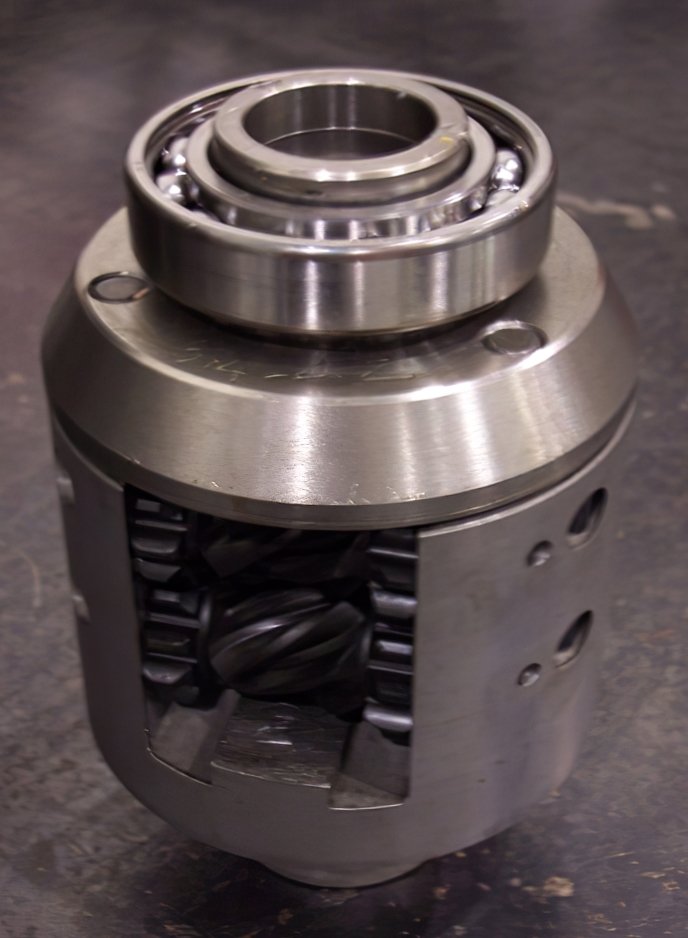
What is Torsen?
A Torsen is a torque-sensing mechanical limited-slip differential that uses worm and helical gears instead of clutches to send power toward the wheel with the most grip.
Torsen is a contraction of "torque sensing," and it describes a family of gear-driven limited-slip differentials rather than a single design. Instead of using clutch packs to resist wheel spin, a Torsen relies on worm gears and helical side gears whose meshing angle makes them easy to drive in one direction but hard to back-drive in the other. That geometric asymmetry is what lets the unit resist one wheel spinning freely while the other has traction, without any electronic sensors, solenoids, or hydraulic clutches involved.
Because the effect comes purely from gear geometry, a Torsen differential reacts instantly and proportionally to torque input. When one wheel loses grip, the unit can redirect a majority of available torque to the wheel that still has traction, up to a bias ratio set by the specific gear design, typically in the range of 2.5:1 to 5:1. This makes it well suited to performance and all-wheel-drive applications where consistent, predictable handling matters more than the ultimate lockup of a clutch-type LSD. Audi has used Torsen center differentials in quattro all-wheel-drive systems since the 1980s, and Toyota, Lexus, and Mazda have used Torsen units in rear differentials on cars like the MX-5 Miata and various Lexus performance models.
The key difference from a clutch-type LSD is that a Torsen has no clutch plates to wear out and no fixed lockup percentage; it behaves purely as a function of torque and gear ratio, which means it does nothing extra when both wheels are simply coasting or spinning at equal speed with equal grip. Compared to an open differential, which always sends equal torque to both wheels and therefore lets the low-grip wheel spin freely while the high-grip wheel gets nothing, a Torsen actively biases torque away from the slipping wheel. One tradeoff is that if one wheel has literally zero traction, such as being lifted off the ground, a purely torque-sensing Torsen has no torque to redirect and can leave the car stuck, which is why some vehicles pair a Torsen with a brake-based torque-vectoring system for that edge case.