DuelsLeaderboardGarageBlogCarsGlossaryBrowse

Paddle shifters

Car culture term

Paddle shifters
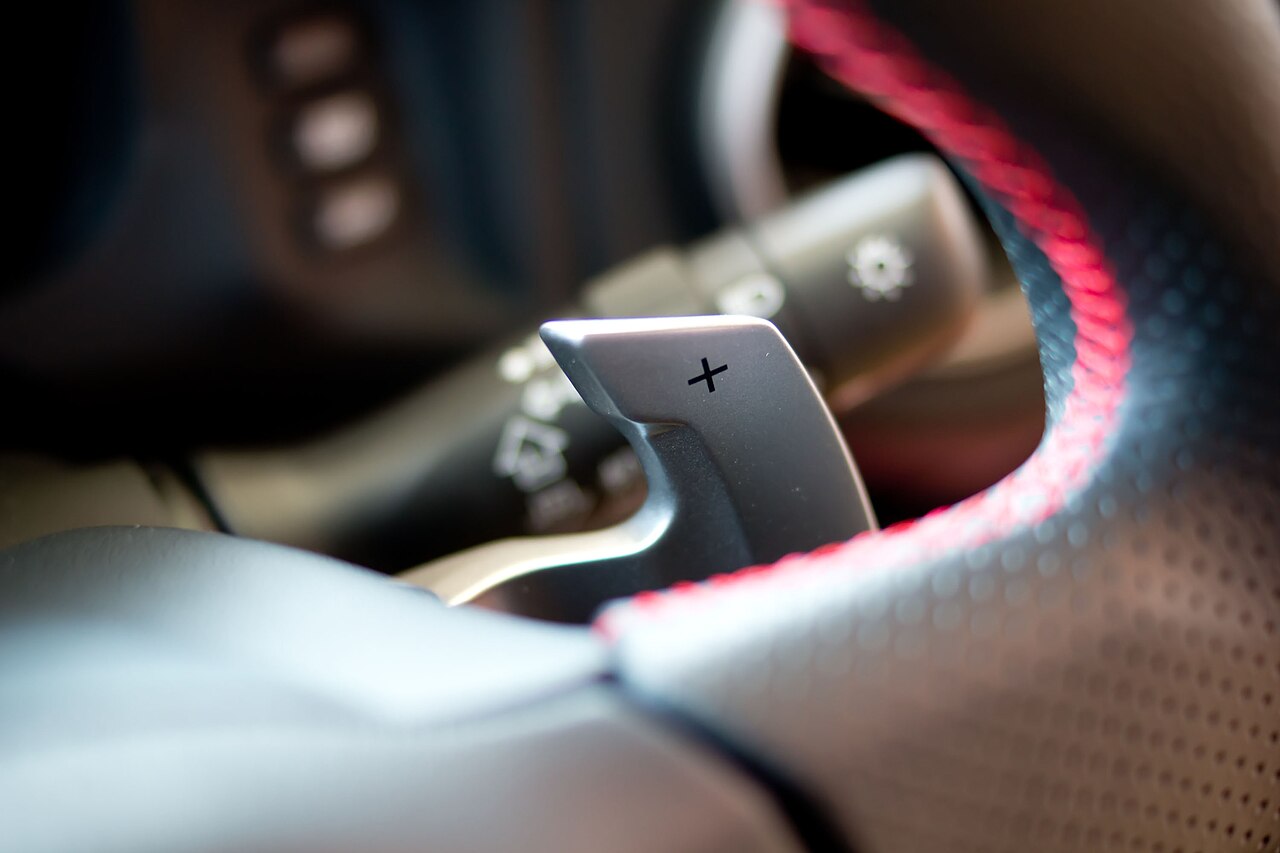
Photo: Cllackr / Wikimedia Commons · CC0

What is Paddle shifters?

Steering wheel-mounted controls allowing manual gear selection in cars with automatic or dual-clutch transmissions. Common in modern performance cars.

Paddle shifters are steering wheel-mounted controls (typically two paddles, one for upshifts and one for downshifts) that allow manual gear selection in cars with automatic or dual-clutch transmissions. The driver can use the paddles to override the automatic shift logic, requesting a specific gear on demand. Paddle shifters are increasingly common in modern performance cars and are now standard equipment in many sport-oriented vehicles.

Paddle shifter implementation varies. Most modern dual-clutch cars (Porsche PDK, BMW DCT, Ferrari, Lamborghini) provide responsive paddle operation with shift times in milliseconds. Traditional automatic transmissions have slower paddle response (tenths of seconds versus the tens of milliseconds of DCTs). Some cars allow full manual operation through paddles (the transmission won't shift unless commanded by the driver), while others have automatic protection (the transmission will shift to prevent over-revving even when the driver hasn't commanded it).

Paddle shifters are typically integrated with the steering wheel, so they move with the wheel during turning. Some performance cars have column-mounted paddles (fixed to the column rather than the wheel), which can be preferable in spirited driving where steering wheel angles change rapidly. Aftermarket paddle shifter conversions are available for some cars without factory paddles.

Related terms

DCTManual transmissionHeel-toe

Frequently asked questions

Are paddle shifters faster than manual transmissions?
Generally yes for modern DCTs. Dual-clutch transmissions with paddle controls shift in 50-200 milliseconds, faster than even expert manual transmission drivers. For traditional automatic transmissions with paddle shifters, the gap is smaller; well-trained manual drivers can sometimes match or beat traditional automatic paddle shifters.
Can I drive a paddle-shift car like a manual?
With practice. Most paddle systems require some adaptation: there is no clutch pedal to coordinate, the throttle response may differ from a manual, and the driver must remember to downshift the paddle to the correct gear (the system won't auto-downshift in some configurations). Most drivers adapt within hours of practice.
Why do steering wheel paddles move with the wheel?
Because they are typically mounted to the wheel. Some performance cars (Ferrari, Lamborghini, Porsche GT3) have column-mounted paddles that don't move during steering. Wheel-mounted paddles are simpler and more common; column-mounted paddles are typically only on focused performance cars where the driver may want to maintain hand position on the wheel during corners.
Do paddle shifters work on automatic transmissions?
Yes, but with slower response than dual-clutch transmissions. Traditional automatics use a torque converter, which has built-in slip and slower shift speed. Paddle shifts on automatics typically take 200-500 milliseconds versus 50-100 milliseconds for dual-clutch. The shifts are still faster than typical D-mode automatic operation.
Are paddle shifters required for performance cars?
Increasingly yes, for new cars. Manual transmissions remain available in some performance cars (Porsche 911 GT3, Ford Mustang, Mazda Miata, Toyota GR86, Honda Civic Type R). Most other modern performance cars use dual-clutch with paddles. The trend is clear: paddles are becoming the default; manual transmissions are increasingly a connoisseur option.
Back to Glossary