Aston Martin Cars
Exotic · 12 models

James Bond car of choice. The DB5, Vantage, DB11, DBS Superleggera, and Valkyrie carry the British grand-tourer lineage forward.
ExoticAston Martin is the British grand tourer brand whose cultural footprint extends well beyond its production volumes thanks to 60+ years of association with James Bond films. The DB5 of Goldfinger is one of the most recognizable cars in cinema history, and subsequent Aston Martins (DB10 from Spectre, DBS from No Time to Die) have continued the partnership. The brand modern lineup centers on grand tourers (DB11, DBS Superleggera, the new Vanquish), the Vantage sports car (mid-engine F1-derived twin-turbo V8), and the DBX SUV. Earlier defining cars include the DB7 (1994-2003, the Ian Callum-designed product that revived the brand in the 1990s), the DB9 (2004-2016, the Ulrich Bez era flagship), and the V12 Vantage (multiple generations of small chassis with V12 engines). The Vulcan (2015) was a track-only special with a 7.0 liter V12 making 820 horsepower. The Valkyrie hypercar (developed with Red Bull Racing F1 expertise) launched in 2020 with a 6.5 liter naturally aspirated V12 from Cosworth, hybrid assistance, and active aerodynamics. Aston Martin has had financial turbulence throughout its history. Multiple ownership changes, near-bankruptcies, and restructurings have shaped the modern company. Lawrence Stroll-led investment group acquired control in 2020 and has invested heavily in product development and Formula One presence (the Aston Martin F1 team). On WhipJury, Aston Martin submissions skew toward DB9, DB11, V8 Vantage (both the modern Mercedes-AMG-engined and earlier 4.3 V8 versions), and DBS Superleggera. Classic DB5 examples are rare but always memorable.
Aston Martin models we cover


The DB lineage
DB4 and DB5 (1958-1965). The David Brown era. Hand-built grand tourers with inline-six engines. The DB5 of Goldfinger (1964) is the most cinematically famous car ever made.
DB7 (1994-2003). Ian Callum-designed revival. Initially based on Jaguar XJS underpinnings. The car that saved Aston Martin in the 1990s.
DB9 (2004-2016). The Ulrich Bez era flagship. VH platform, 6.0 liter V12, around 470 to 540 horsepower across the run. Defined the modern Aston Martin grand tourer aesthetic.
DB11 (2016-2023). Replaced DB9. Initially with twin-turbo V12, later with Mercedes-AMG twin-turbo V8. AMR variant was the focused performance trim.
DB12 (2023-present). Current grand tourer. AMG-derived twin-turbo V8 only. The brand has called the DB12 a super tourer, positioning above grand tourer.
The Vantage
The current Vantage uses a Mercedes-AMG twin-turbo V8 making 656 horsepower in latest form. Compact two-seat sports car body, rear-drive, eight-speed automatic. The previous-generation V8 Vantage S and V12 Vantage S (with the brand 6.0 V12) are the connoisseur picks for analog character. The earlier V12 Vantage Manual is now a cult collector item.
Aston Martin on WhipJury
Modern DB11 and DBS Superleggera submissions are common. Earlier DB9 examples are popular as the more affordable used Aston option. Classic DB5 examples are rare but always do well in voting. The community here recognizes Aston Martin as the British grand tourer that has somehow survived 60 years of financial drama.
Frequently asked questions about Aston Martin
Aston Martin on the WhipJury blog
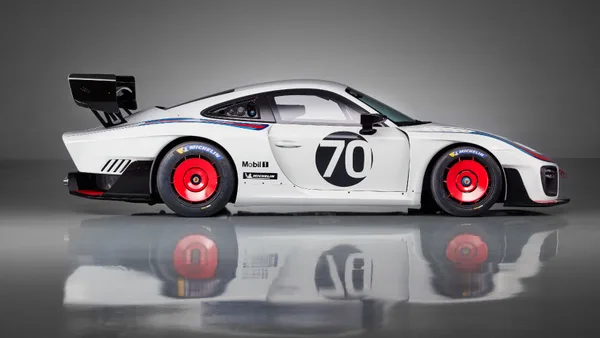
John Ternus became Apple's CEO on September 1. He's also an amateur racer who reportedly laps Laguna Seca in under 1:40 in a Porsche 935, a 700-hp track car Porsche built just 77 of.

Car culture has its own language and it moves fast. A conversation about a Skyline build can cover RB26 specs, ATTESA AWD, coilovers, hellaflush stance, and RWB widebody kits before you've finished your first coffee. If you don't know the vocabulary, you're not lost exactly, but you're definitely translating while everyone else is talking.

The debate about two-door versus four-door cars almost always ends up in the same place. Two doors look better. Four doors are more practical. Case closed, move on. But that framing skips over something more interesting, which is why the two-door almost always looks better, what specifically it does to a car's proportions, and the cases where the four-door actually wins...

Rating a car sounds simple. You look at it, you feel something, you pick a number. But spend any time on WhipJury and you start to notice that the people with the most consistent, most respected ratings aren't just going with their gut. They're applying a real standard...